

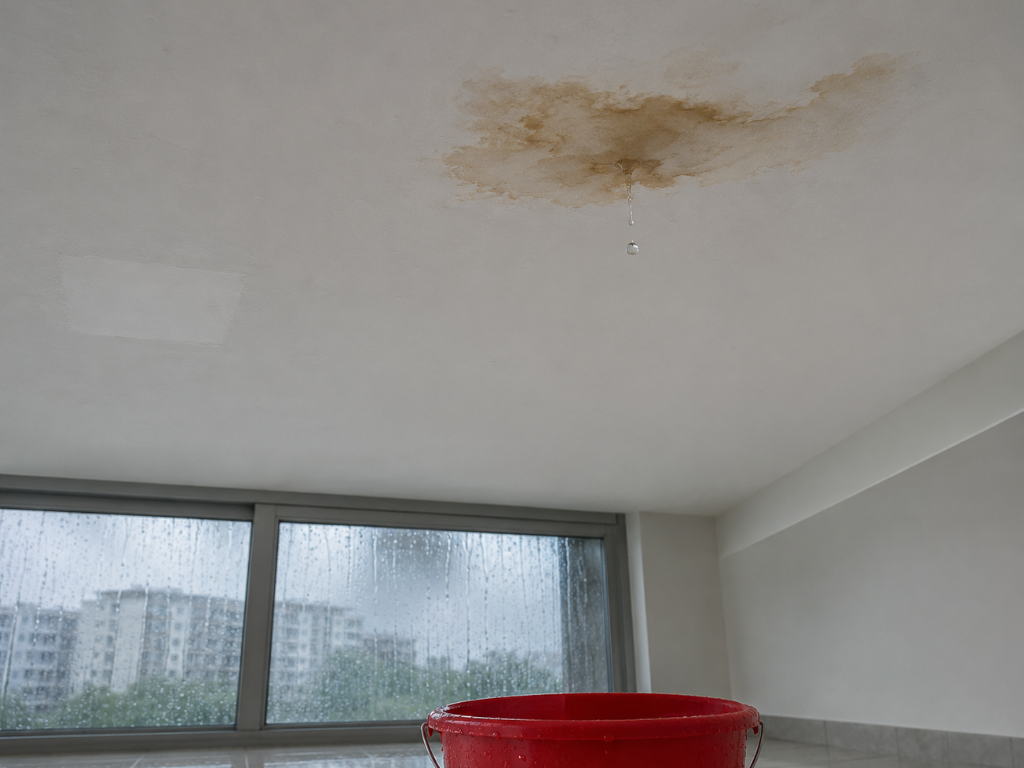
A roof still leaking after repair usually means the repair was done in the wrong place, or it closed one gap while water kept coming in through another. It matters now, because the October and November storms are when a weak repair gets found out. Proof-Tech repairs roof leaks for condominiums, commercial buildings and landed houses in Singapore, and our roof leakage repair service page lists the roof leak work we take on.
Why is my roof still leaking after repair?
Because the repair treated the stain instead of the place where water gets in. Water rarely drops straight down. It gets in at one point and runs along the slab, a roof beam or the underside of the membrane. Then it drips out at the first low spot it finds, which can be two or three metres away.
Say a contractor climbs up, finds a crack right above the stain and seals it. That crack may be real and still not be the problem. The ceiling dries for a few weeks, the next big storm arrives, and the stain comes back in the same place. That is a misdiagnosis, and it means paying for the same leak twice.
The second common reason is a repair that cannot last in our weather. Sealant smeared over a crack, a screw head or a joint looks fine on the day. Singapore’s sun heats the roof every afternoon and the rain cools it at night. Within months the sealant hardens and splits.
A third reason is a new coat laid over an old membrane that was already holding water. The new layer looks clean, but the water stays trapped underneath and keeps finding its way into the building.
Sometimes the leak was never coming from the roof. If your ceiling gets wet on dry days, check the aircon drain pipes and the plumbing above first. Don’t pay anyone to touch the roof until those are ruled out.
Why does my roof only leak during heavy rain in Singapore?
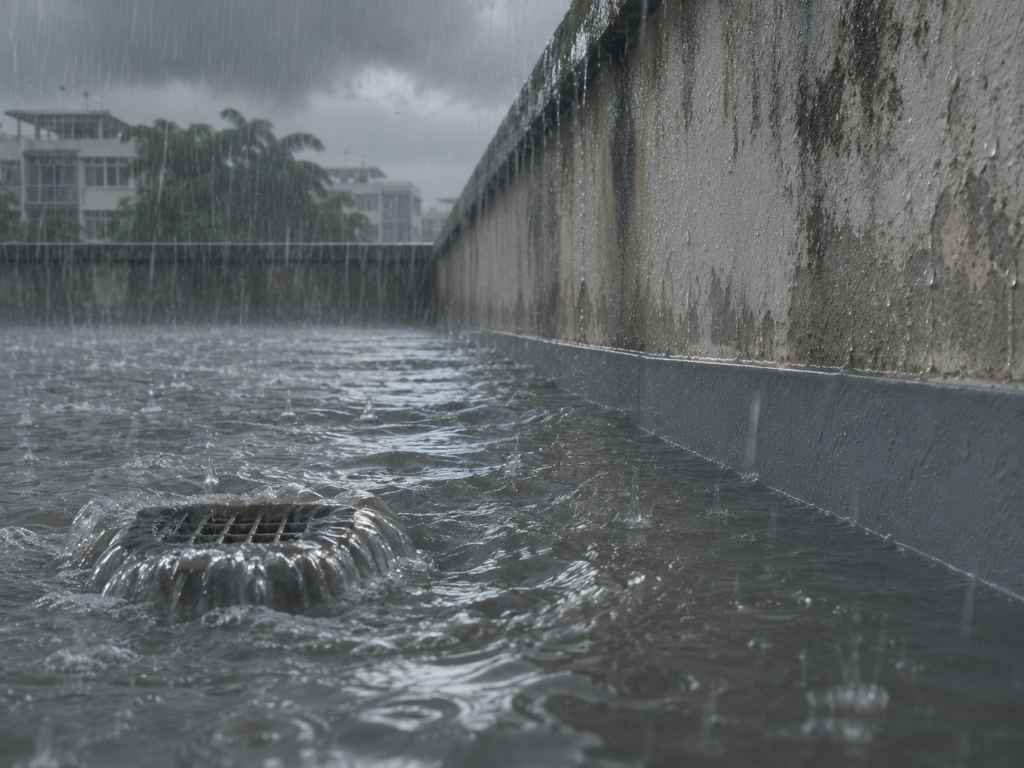
A roof leaking during heavy rain in Singapore, but dry in light showers, is telling you where to look. Light rain runs off. A heavy thunderstorm drops more water than the drain outlets and gutters can carry. For 20 or 30 minutes the water on the roof rises and reaches joints that stay dry the rest of the time.
On a flat roof, that rising water climbs past a short upturn, which is the edge of the membrane turned up the parapet wall. It also gets into membrane laps, where two sheets overlap and were not bonded properly. On a pitched or metal roof, a blocked gutter overflows backwards. The water runs under the flashing, the metal strip that seals the roof against a wall or ridge.
Wind is the other trigger. Inter-monsoon thunderstorms run through October and November. The Northeast Monsoon then sets in around the end of November and lasts to about March. NEA’s monsoon advisory also warns of Sumatra squalls with gusty winds on some mornings. Those gusts push rain sideways, under laps and flashing built for rain falling straight down.
That is why a roof repaired in a dry month can pass a hose test and still leak in its first real storm. Write down when your leak shows up: during the rain, an hour after, or only when the wind blows from one side. That timing tells a contractor more than a photo of the stain does.
Where do repeat leaks start on each type of roof?
Repeat leaks on each roof type start in a few predictable places, and a repair that skips them fails again.
| Roof type | Where repeat leaks usually start | What a lasting fix looks like |
| RC flat roof (concrete slab with a waterproofing layer on top) | Upturns at parapet walls, membrane laps, drain outlets, ponding areas (puddles that sit for days), and holes cut for pipes, aircon brackets or water tank supports | Repair the failed detail with a compatible membrane, fix the ponding, then flood test |
| Metal roof | Rubber washers under the screws that have perished, overlaps between sheets, ridge capping, wall flashing and box gutters | Replace the screws, washers and flashing, then clear or enlarge the gutters. Sealant on its own is a stopgap |
| Clay or concrete tiles | Cracked or slipped tiles, loose ridge mortar, valley flashing, and the underlay sheet beneath the tiles | Replace tiles, repoint the ridge and renew the underlay where it has rotted. A coating will not seal a leak |
Watch for ponding on a flat roof. If puddles are still there two days after the rain stops, either the slab does not slope properly to the outlets or the outlets are blocked. Standing water works on every weak lap and patch around it. Patch the leak without fixing the ponding, and the same patch gets tested every week.
On tile roofs, don’t pay for a coating to stop a leak. Water coming in through the ridge, the valleys or a rotted underlay goes straight past a fresh coat. Our guide to roof tile coating explains when coating is worth paying for.
Roof still leaking after repair: should you call the same contractor back?
Call them back first, in writing, if the repair is still under warranty. Send dated photos of the leak taken during rain, with the repair date and the invoice. Ask them to inspect while it is raining or soon after. A call-back costs nothing if the warranty is honoured. It also puts on record that the leak came back inside the warranty period.
Read the warranty before they arrive. If it names only the area that was patched, a leak a metre away will be called a new leak and quoted again. Our guide to waterproofing warranties explains the difference between workmanship cover and material cover.
Then judge the visit. Give them the job again if they test before repairing and can tell you why the first repair failed. Get a second opinion if they plan more sealant on the same spot, or cannot show you where the water gets in.
Who should I contact for roof leakage repair in Singapore?
Contact whoever owns the roof, and that changes with the type of property.
In a condominium, the roof is common property, so the MCST is responsible for repairing it and paying for it. Report the leak in writing to the managing agent with dated photos. Do this even if you are the top-floor owner and the water is only in your unit. Our article on who pays for condo leaks covers what to do if the MCST does not act.
If the development is new and still inside its defects liability period, report the leak to the developer in writing as well as to the MCST. Defects that appear in that period are the developer’s to put right under the sale and purchase agreement. Keep copies of everything you send.
In a landed house, you own the roof, so you call the contractor yourself. For a commercial building, report it to the management corporation or building manager. Tenants report to the landlord, as their lease sets out. HDB residents go through their town council.
Patch the roof again or re-waterproof it?
Patch again when the leak comes from one detail and the rest of the roof is sound. Re-waterproof when the membrane is worn out across the roof. At that point each new patch only moves the leak to the next weak spot.
These signs point to re-waterproofing:
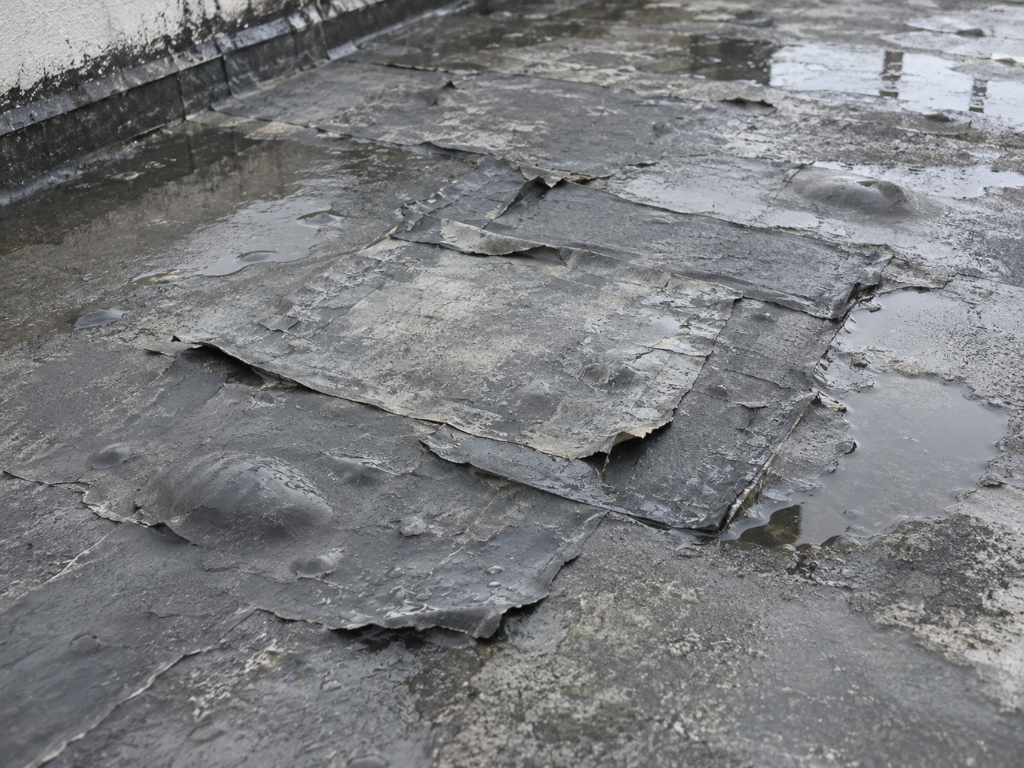
- the membrane is brittle, cracked across open areas, or lifts when you press it
- there are blisters, or patches laid over older patches
- large areas hold water after rain
- leaks show up in more than one room
- the roof has been patched two or three times and still leaks
A detail repair costs far less than a full re-waterproofing, which is why owners try it first. A third patch on a membrane that is failing everywhere ends up costing more. Every call-out is billed again, and the ceiling and paint underneath keep getting damaged.
The right roof leakage solution for your building comes down to what a test shows. That means how many entry points there are, and the condition of the membrane around them.
For a straight answer on your roof, we need photos of the ceiling stain and the roof above it. Add the dates it leaked and the invoice or scope from the last repair. With those, we can tell you whether a missed detail is to blame or the roof needs waterproofing works across the whole area.
How do you know the new repair actually worked?
Test it before you pay the final invoice, instead of waiting for the next storm. On an RC flat roof, ask for a flood test. The outlets are plugged, the slab is covered with water and left for at least 24 hours, and someone checks the ceiling below. If the ceiling stays dry, the membrane is holding.
A pitched or metal roof cannot be flooded, so it gets a water test instead. Water is run over one section at a time, starting at the bottom and working up, so any leak shows which section let it in.
Ask for photos before, during and after the work, and keep them with the invoice. If the leak returns, those photos turn a warranty call-back into a quick fix instead of an argument. For flat roofs, ask which standard the contractor works to. The Singapore code of practice for waterproofing concrete buildings is SS 637:2018.
Conclusion
If your roof is still leaking after repair, stop paying for patches until someone has found where the water gets in. Test first, repair the detail that failed, and re-waterproof only if the membrane is worn out across the roof.
To confirm which applies to you, we need photos of the stain and the roof above it, the dates it leaked and the last repair invoice. Send them through our enquiry form for a no-obligation quote, or call +65 6100 7558.
Frequently asked questions
How soon after a roof repair will I know it has failed?
After the first heavy storm. Light rain proves nothing, because it doesn’t build up enough water to reach a weak upturn or lap. If the ceiling is wet after the first proper downpour, the repair has failed or missed the source. Photograph the leak while it is active and report it the same day.
Can I stop a roof leak myself with sealant?
Only as a stopgap until a contractor arrives. Sealant over a crack or screw holds for weeks, then splits in the heat. It also hides where the water was getting in. And climbing a wet roof is how people get hurt. Put down a bucket, move anything electrical out of the way, then call Proof-Tech for a no-obligation quote.
Is a ceiling that keeps leaking dangerous?
It can be. Wet gypsum ceiling board sags and can fall in sections. Water near light fittings or the electrical box is a shock and short-circuit risk. Switch off the circuit for that room if water is near a fitting. Then keep people out from under the sag until the source is traced.
Will laying a new membrane over the old one stop the leak?
Only if the old layer is dry and still firmly stuck down. A new membrane laid over a wet or loose one traps the water, and the leak comes back. Ask any contractor, including Proof-Tech, how they will deal with the existing layer at the leak points before the new system goes on.