


Who is responsible for water leakage in a condo in Singapore starts with a statutory presumption rather than a plumber’s opinion. Section 101(8) of the Building (Strata Management) Act presumes the defect sits in the lot or common property immediately above the damp ceiling, unless proven otherwise. This blog walks you through the rules, alongside ceiling leak repair for condominiums.
Who is responsible for water leakage in a condominium?
The party that owns the defective element pays. If the water comes from a pipe, floor or wet area inside the unit above, that subsidiary proprietor pays; if it comes from common property such as the roof, external wall or a structural slab, the MCST pays from common funds.
The law leans one way at the start. Section 101(8) presumes the defect is above, so the owner below does not have to prove where the water comes from before anyone acts.
Ownership is defined, not negotiable. The Act treats structural elements and the waterproof membrane attached to an external wall or roof as common property, even where they sit within a lot, while finishes and fittings inside the unit belong to the subsidiary proprietor.
The renaming caught many managing agents mid-cycle. The Building Maintenance and Strata Management Act became the Building (Strata Management) Act on 1 October 2025, and the building maintenance provisions moved into Part 4A of the Building Control Act on the same date.
Worth noting: the presumption decides who starts, not who ends up paying. A leak investigation that traces water to a cracked riser pipe in a shaft shifts the cost back to the MCST regardless of which ceiling is stained.
What does section 101(8) actually say?
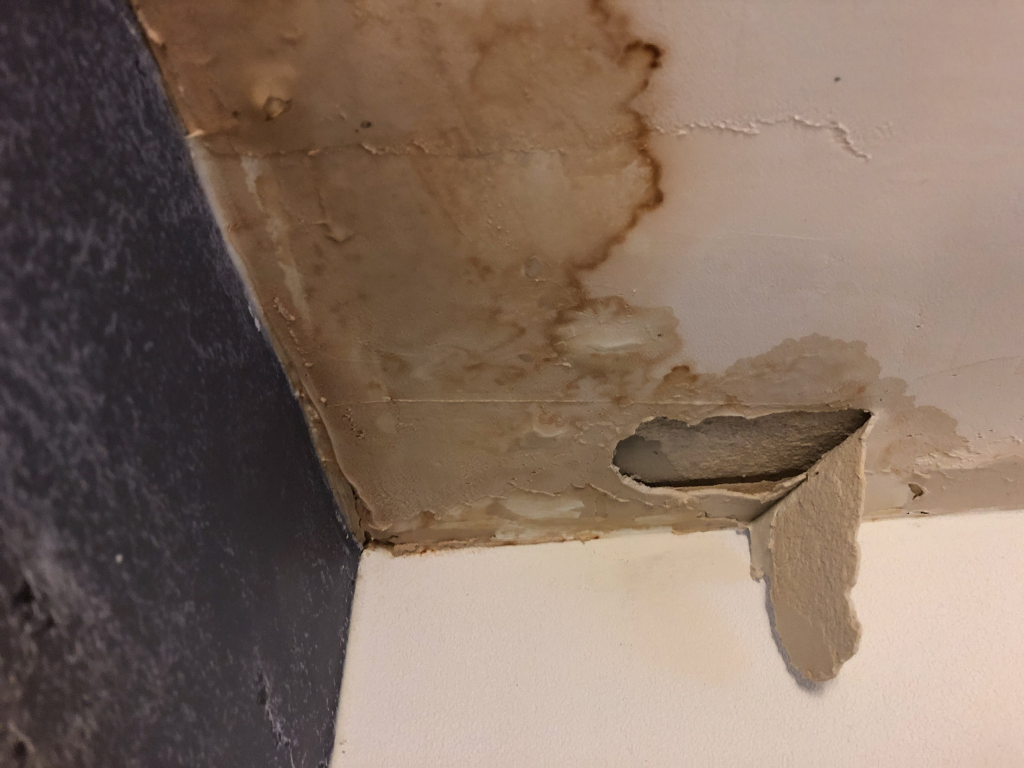
It creates a rebuttable presumption in Strata Titles Boards proceedings. Where there is evidence of dampness, moisture or water penetration on a ceiling, section 101(8) presumes, in the absence of proof to the contrary, that the defect is in the lot, common property or limited common property immediately above.
Three limits matter. The presumption applies in proceedings under section 101, not as a general rule of neighbourly liability. It is rebuttable by evidence. It covers the finishing material attached to the ceiling, including plaster, panel and gypsum board, so a stain on a false ceiling counts.
The presumption also cuts towards the MCST. The wording names common property and limited common property immediately above alongside the lot above, which means a leak under a roof slab, a corridor or a landscaped deck sits with the management corporation.
In practice, the presumption ends the stalling. An upstairs owner who refuses to investigate carries the risk of an adverse finding at the Board, and that changes the tone of the first conversation.
When is a condo leak the MCST’s responsibility?
When the source is common property. That covers the roof and its waterproofing, external walls and the membrane attached to them, structural slabs, common risers and pipes serving more than one lot.
Section 29(1)(b) makes this a duty, not a discretion. The MCST must maintain common property and keep it in good and serviceable repair, renewing or replacing it where reasonably necessary.
A 2026 decision put a boundary around the argument that waterproofing is an upgrade. In STB No. 31 of 2026, the Board recalled that in Fu Loong Lithographer, adding waterproof flashings “so as to make the common property waterproof, even where none existed originally” was treated as replacement under section 29(1)(b).
That matters for funding. Replacement under the maintenance duty proceeds on the council’s authority and the sinking fund; an improvement under section 29(1)(d) needs a special resolution, which is where repairs stall for a year.
Limited common property changes little. Walls, roofs and windows in external walls are excluded from it, so the facade and roof stay with the MCST even in estates that have carved out exclusive areas.
When does the upstairs owner pay?
When the defect sits inside the lot. Failed floor waterproofing in a bathroom, a leaking flexible hose, a cracked floor trap, an unsealed penetration from a renovation and a defective water heater connection are all lot items.
Renovation history is the usual trigger. Hacking and re-tiling a bathroom without renewing the membrane leaves the screed as the only barrier, and the leak appears in the unit below months after the contractor has left.
The MCST has a recovery route where an owner causes the damage. Section 30 lets it carry out work the owner failed to do under a public authority notice and recover the cost, and to recover expenditure made necessary by a person’s wilful or negligent act or breach of the by-laws.
Our position: the upstairs owner should commission the investigation early rather than wait for the Board. The common causes of ceiling leaks are few enough that a competent test sequence resolves most cases in a day or two.
What if the leak comes from the roof or an external wall?
That is common property, and the MCST pays. Top-floor units report ceiling leaks after heavy rain because the roof membrane, not the neighbour’s bathroom, has failed.
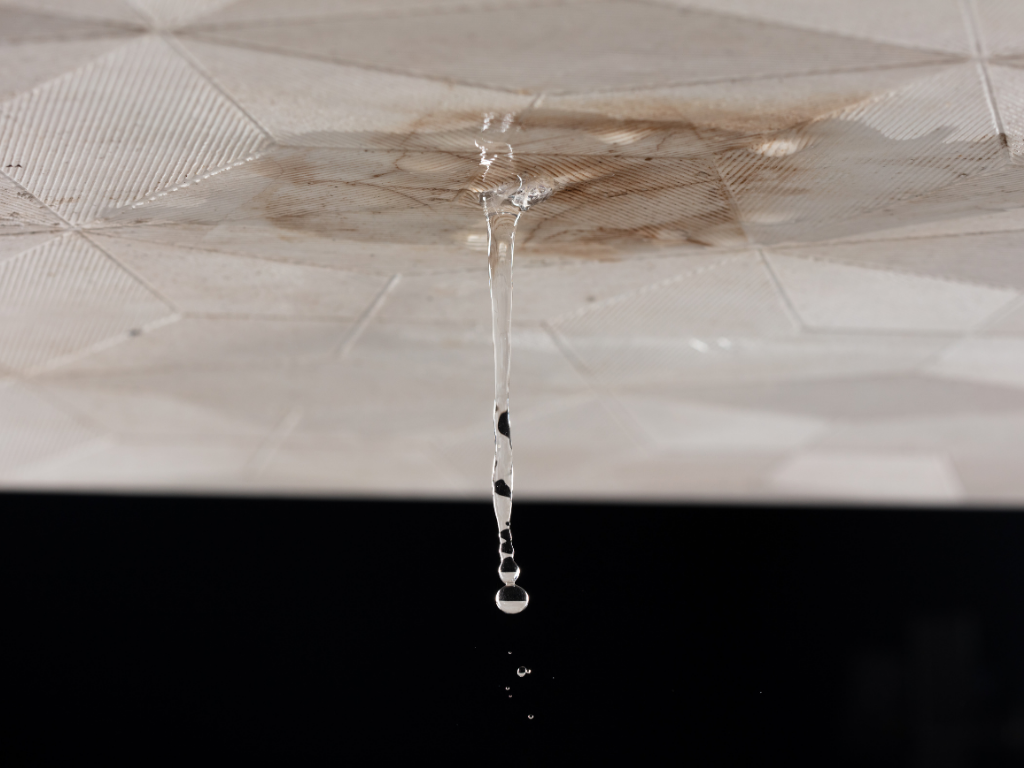
The tell is timing. A leak that appears during or shortly after rain, and dries between storms, points to the building envelope. A leak that persists in dry weather points to plumbing or a wet area above.
Roof-origin leaks need the source fixed, not the ceiling patched. Roof leak rectification starts at the membrane, upstands and outlets, and ends with a water test before any ceiling reinstatement.
External wall seepage behaves similarly. Water tracks along slabs and appears metres from the entry point, which is why wall and ceiling stains rarely sit under the defect.
Evidence should be dated. Photographs taken during rain, with times recorded, are what separates an envelope claim from a plumbing dispute at the Board.
Top-floor owners should ask for the roof’s last waterproofing date and its ponding test record. BCA’s Quality Mark Scheme guide sets that test at a minimum of 24 hours, and an estate that cannot produce one has no evidence the roof was ever verified.
What should you do first when your ceiling starts leaking?
Notify the MCST and the unit above in writing on the same day, then arrange a joint inspection. Written notice starts the paper trail the Board will want to see.
Record the evidence before anyone repairs anything. Dated photographs, the location of the stain relative to the unit above, meter readings of moisture and the weather on the day all support the later finding.
Ask the managing agent to coordinate access. A joint inspection with the upstairs owner, the managing agent and one contractor present avoids two conflicting reports.
Do not accept a cosmetic repair as closure. Repainting a stained ceiling hides the symptom, and spotting a leak early is worth more than a tidy finish while the source keeps running.
Agree who pays for the investigation before it starts. Splitting the investigation cost between the two owners, with the loser reimbursing, keeps the process moving while liability is still open.
How do you prove the leak is not from your unit?
By isolating the sources one at a time and documenting each result. The presumption in section 101(8) is rebuttable, and a structured test sequence is what rebuts it.
A defensible investigation tests one element at a time: the floor trap, the shower area, the WC connection, the basin waste, the concealed pipework under pressure, and finally the slab itself. Each test runs long enough for water to travel, with the ceiling below observed and photographed.
Supporting tools sharpen the picture. Moisture meters map the wet zone, thermal imaging shows temperature differences behind finishes, and a dye test confirms which fitting feeds the stain.
Where the test points to a slab crack rather than a fitting, PU injection grouting seals the path from below without hacking the neighbour’s floor.
The report is the product. Name the tests, the durations, the results and the conclusion, because that is the document the managing agent, the insurer and the Board will read.
What if the MCST does nothing?
The Act converts silence into a decision. Under section 101(5), where an owner applies to the MCST to exercise a power or duty and the MCST neither acts nor informs the applicant of a refusal within 2 months, it is deemed to have decided not to act.
That deemed refusal unlocks the Board. Section 101(1)(c) covers the failure to exercise or perform a duty under the Act or by-laws, which is the head an owner uses when common property repairs stall.
Put the request in writing and date it. A letter to the council and managing agent asking for a specific action, with a copy retained, is what starts the 2-month clock.
Section 101(3) gives the remedy teeth. The Board can order damages up to the amount a District Court could award had the dispute been litigated there.
Where this breaks down is the owner who complains verbally for a year and then discovers there is no record of a request the Board can act on.
How does a Strata Titles Boards application work, and what does it cost?
Filing costs $500. The Strata Titles Boards’ FAQ, updated 8 June 2026, states the fee is set by the Building Maintenance and Strata Management (Strata Titles Boards) Regulations 2005 and covers 2 mediation sessions plus processing and administration; there is no refund.
Proceedings run in four stages: application, mediation, hearing and post-hearing. Mediation is compulsory for both parties, and the $500 fee covers two sessions before any hearing.
The Board publishes a pre-filing assessment tool for disputes under the Act, and applications are checked by email before payment and hard-copy filing. Orders are binding and enforceable at the Singapore State Courts.
Evidence decides outcomes. Owners who arrive with a dated investigation report, photographs and correspondence get shorter proceedings than owners who arrive with an argument.
Fixing the source remains the point. Whatever the Board orders, the money is better spent on preventing repeat water damage than on a second round of mediation two years later.
Conclusion
The law gives the lower-floor owner a head start and nothing more. Section 101(8) presumes the defect sits immediately above, including in common property, and a documented isolation test is the only thing that moves that presumption. Ownership of the defective element decides who pays, section 101(5) stops an MCST from running out the clock, and $500 buys a hearing when talking fails.
Send Proof-Tech photographs of the stain, the unit layout and any correspondence for a leak investigation and a written report identifying the source and the rectification scope.
Frequently asked questions
How much does a condo ceiling leak repair cost in Singapore?
Published 2026 rates put most ceiling leak repairs between $600 and $1,800 when the source is fixed by PU injection, according to Flux Solutions, while General.com.sg prices PU crack injection at $280 to $1,200 and a full ceiling repair at $500 to $3,500. Leak investigation is charged separately.
Can I force my neighbour to let a contractor into their unit?
Not directly. Ask the MCST to coordinate access, and if the owner refuses, apply to a Strata Titles Board under section 101 of the Building (Strata Management) Act. The Board can make orders binding on the subsidiary proprietor, enforceable at the State Courts.
Does the MCST pay to repair the damage inside my unit?
Only where the source was common property and the MCST’s duty under section 29(1)(b) was engaged. Reinstatement of finishes inside a lot falls to the owner or an insurer. Ask the managing agent what the estate’s policy covers before assuming the MCST will repaint your ceiling.