

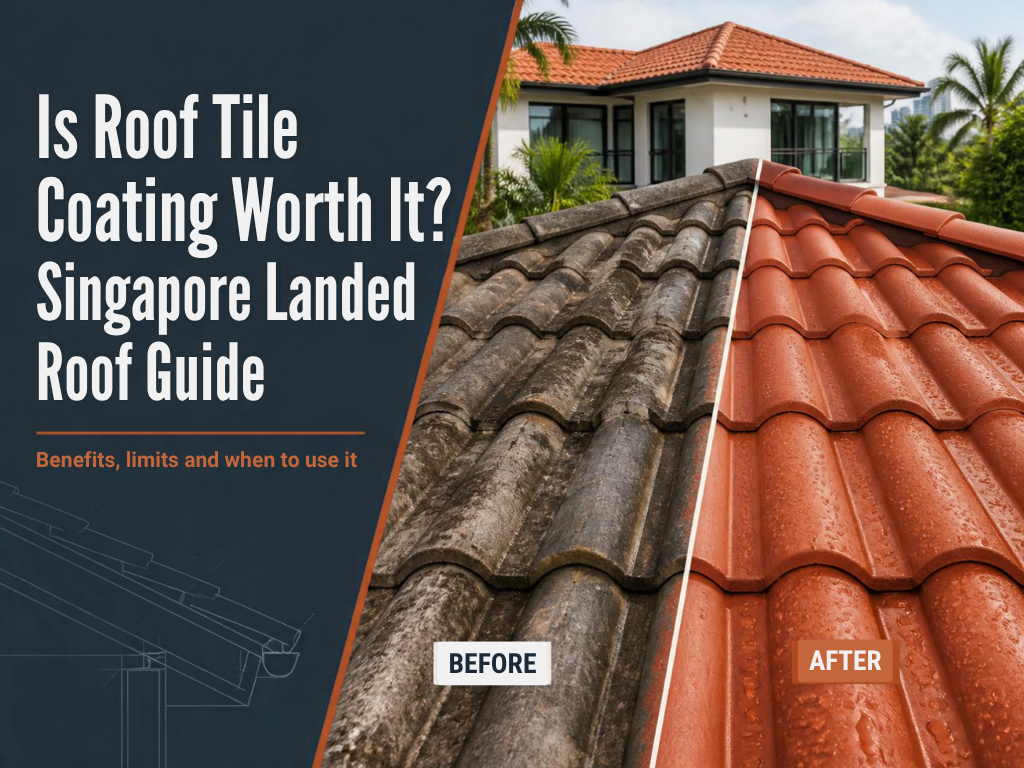
Roof tile coating is worth it when the tiles are sound and the problem is porosity, moss or heat. It is not worth it when water is entering through a failed underlay, cracked ridge mortar or flashing. Published 2026 rates put restoration at $25 to $60 per square metre. This blog walks you through the decision, alongside roof tile coating works.
Is roof tile coating worth it for a landed house?
Coating earns its money on a roof whose tiles are intact and whose leaks, if any, have already been traced and repaired. It buys colour, surface protection and a cooler roof for a fraction of a re-roof, and it buys nothing at all on a roof leaking through the layer beneath the tiles.
Three conditions make it a good decision. The tiles are unbroken and still properly seated, the ridge capping is sound or is being re-pointed as part of the works, and the owner wants another 5 to 10 years out of the existing roof rather than a replacement now.
Two conditions make it a poor one. Water has already reached the ceiling through the underlay, or the tiles have started cracking across the field of the roof rather than in isolated spots.
Scale explains the appeal. Published 2026 figures from The Roof Specialist put roof restoration with cleaning, re-pointing and protective coating at $25 to $60 per square metre against $80 to $220 per square metre for tile replacement.
Worth noting: coating a roof that needs re-roofing does not delay the re-roof. It hides the evidence for a year or two while the battens and underlay keep degrading.
What does roof tile coating actually do?
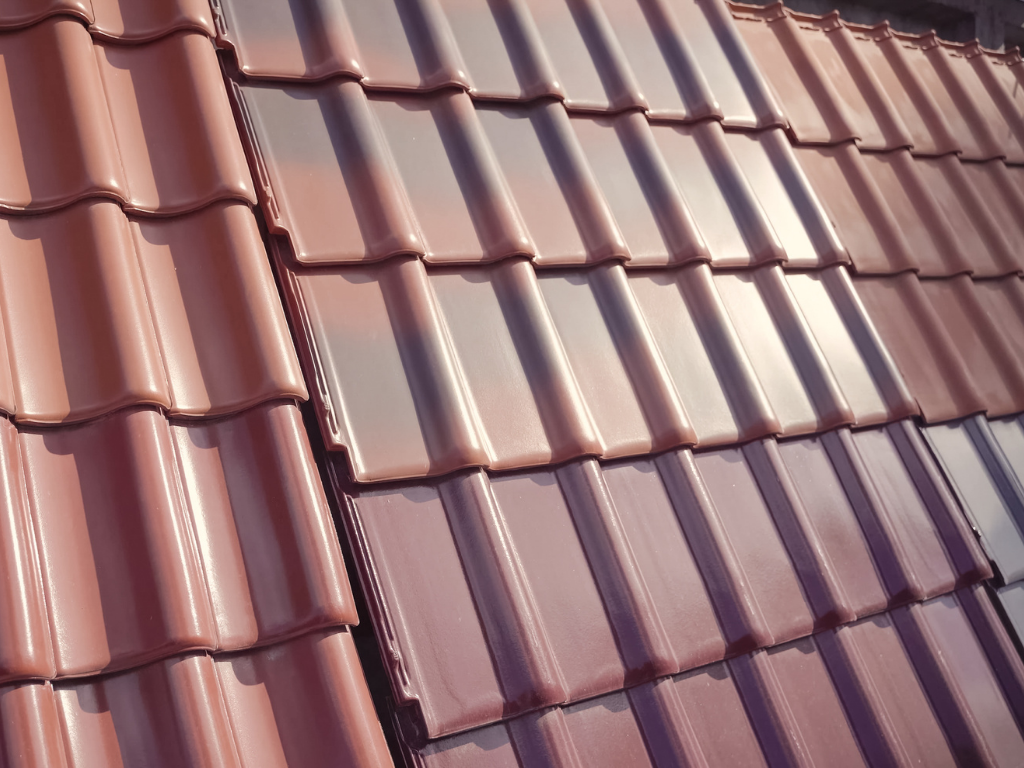
It seals the porous upper surface of the tile, restores colour, and resists the moss, algae and lichen that grow on shaded roof slopes in a humid climate. A light-coloured coating also raises solar reflectance, which lowers roof surface temperature.
Concrete tiles absorb water. An uncoated concrete tile takes up moisture on every rainfall, which feeds biological growth, adds weight and speeds surface erosion. A coating reduces that absorption.
The build-up matters more than the brand. A proper system is a primer plus two topcoats, applied after the roof has been washed and repaired, with each coat given its stated recoat interval.
Colour is part of the value on a landed house. Faded 1990s concrete tiles read as an ageing house, and a uniform coating changes the look of the elevation for a fraction of a re-roof.
What the coating does not do is become a waterproof membrane. It follows the tile surface and leaves every lap, joint and fixing hole exactly as it was.
Will coating stop my roof from leaking?
No, not on its own. A tiled pitched roof is a drained system rather than a sealed one: tiles shed most of the water, and the underlay beneath them catches what blows through the laps.
Leaks on landed houses start at four places. Cracked or slipped tiles, failed ridge and hip pointing, flashing at abutments and chimneys, and the underlay itself once it has gone brittle.
Coating addresses none of those four. It sits on top of the tile, so water entering at a ridge joint or running under a lifted tile passes beneath it untouched.
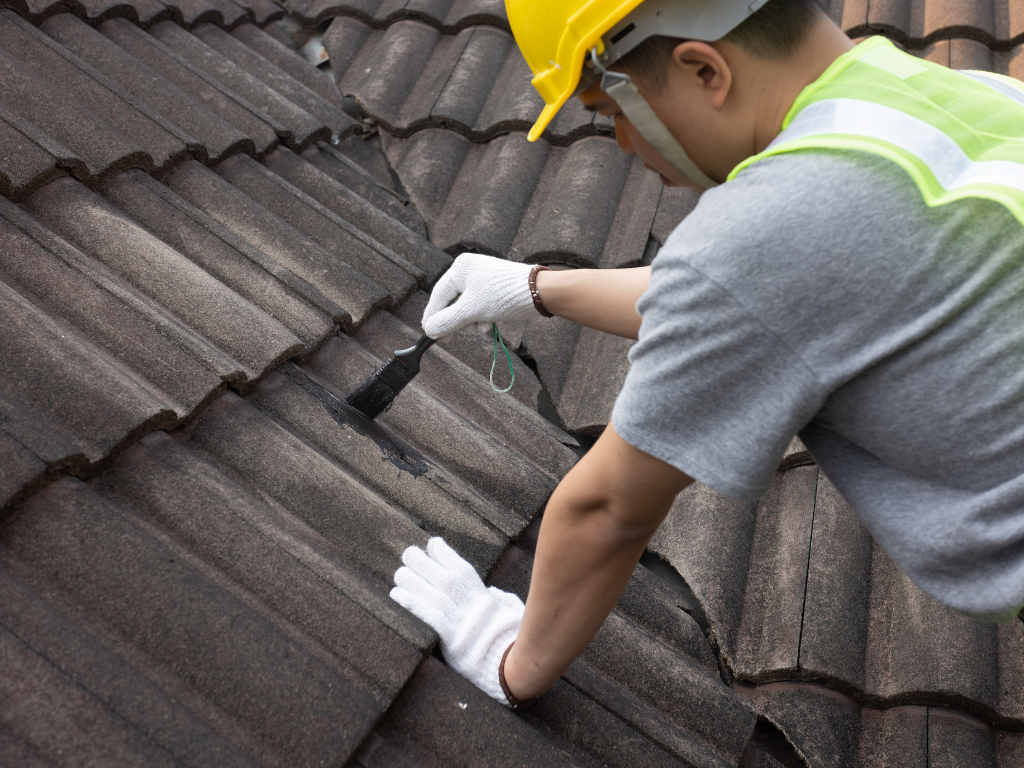
The sequence that works is repair first, coat second. Broken tiles replaced, ridge re-pointed, valleys and flashing checked, then the coating applied over a roof that is already watertight, which is what tile repair and restoration covers before any spray gun comes out.
Where this breaks down is the quotation that offers coating as a leak fix. If the contractor has not traced the leak first, the coating is being sold as a guess.
How long does roof tile coating last in Singapore?
Expect 5 to 10 years of appearance and surface protection, with the reflective benefit fading sooner than the colour. Nothing about a coating extends the life of the underlay beneath it.
Soiling is the first thing to go. Published weathering research on cool coatings records solar reflectance dropping most steeply during the first six months of exposure, as dust and biological growth settle on the surface.
Singapore accelerates every part of that. Daily UV, rain in every month and high humidity on shaded slopes give moss and algae ideal conditions, which is why maintenance in a tropical climate treats washing as a recurring task rather than a one-off.
Aspect changes the answer across one roof. A north-facing slope shaded by mature trees will regrow growth years before the sun-baked slope opposite it.
Plan a wash at the midpoint rather than a recoat at the end. Removing growth at year four or five keeps the film working and defers the next full application.
Coating or replacing the tiles: what does each cost?
Restoration costs roughly a quarter to a third of replacement per square metre, based on rates Singapore contractors published in 2026. The gap is what the decision turns on.
| Scope | Published 2026 rate | Source |
| Roof restoration: clean, re-point, protective coating | $25 to $60 per m² | The Roof Specialist |
| Roof tile replacement | $80 to $220 per m² | The Roof Specialist |
| Partial or full re-roofing | $80 to $150 per m² | HighTech Roofing |
| Minor tile repairs, individual tiles and ridge sealant | $450 to $1,200 | HighTech Roofing |
| Full landed roof replacement project | $12,000 to $35,000, bungalows $35,000 to $65,000 | contractors.com.sg |
| Full tile replacement project, 150 to 250 m² | $18,000 to $45,000 | The Roof Specialist |
Run it on one roof. At 200 square metres, restoration lands between $5,000 and $12,000 while tile replacement lands between $16,000 and $44,000, which buys a decision window of several years for the price of the smaller job.
Check the area before comparing rates. The Roof Specialist works from 150 to 250 square metres for a landed roof while contractors.com.sg assumes 330 to 350 square metres for a 2.5-storey terrace, so two honest per-square-metre quotes can differ by double on total.
These are other contractors’ published figures rather than independent benchmarks, and none includes GST at 9%.
Clay or concrete tiles: does the tile type change the answer?
Yes. Concrete tiles take coatings well because their surface is porous and the original pigment fades; clay tiles are dense, fired and do not need the sealing that concrete does.
Most Singapore landed homes built between 1980 and 2010 carry concrete tiles, which is the stock that coating suits. The fading, chalking and moss those roofs show are surface problems on a sound tile.
Clay and terracotta roofs age differently. Their colour is fired in rather than applied, so a coating changes the appearance more than it protects the material, and on heritage or conservation properties it changes the character of the roof.
Slipped and broken tiles matter more than the material on either roof. A clay tile that has cracked from foot traffic during a solar panel installation needs replacing, not coating.
Ask the contractor to identify the tile type and profile in writing. Replacement tiles for discontinued profiles are the item that delays a job, whichever route you take.
Does a reflective roof coating make the house cooler?
Yes, measurably, when the coating is light coloured and the roof is the main heat path. A Singapore modelling study of cool roof heat transfer in a tropical climate found a coating with solar reflectance of 0.74 cutting peak roof temperature by up to 14.1°C, indoor air temperature by 2.4°C and daily heat gain through the roof by 54%.
Local research keeps returning to the same lever. The joint NUS, BCA and NParks study published in Applied Energy on 4 June 2025 measured roof surface temperatures falling by up to 4.7°C under a combined green roof and solar panel set-up. Associate Professor Stephen Tay described the benefits as running “from improving solar panel performance and supporting greenery growth, to lowering roof surface temperature.”
Two conditions decide whether a homeowner feels it. The rooms below have to sit directly under the roof, and the coating has to be light; a dark charcoal finish chosen for looks gives up most of the thermal benefit.
Insulation changes the maths too. On a house with an insulated ceiling and an unoccupied roof void, the indoor difference is smaller than the surface temperature number suggests.
In practice, treat cooling as a bonus on a restoration that was already justified by the tile condition.
What should a roof tile coating quotation include?
Six items. Anything missing is either being skipped or will arrive later as a variation.
| Scope item | Why it matters |
| Roof inspection and leak trace | Establishes whether coating is the right scope at all |
| Replacement of broken and slipped tiles | Counted and priced per tile, with profile matched |
| Ridge and hip re-pointing | The most common leak path on a tiled landed roof |
| Valley and flashing check | Junctions that coating never reaches |
| Pressure wash and biological treatment | Removes growth so the primer bonds |
| Primer plus two topcoats | The system, with product names and recoat intervals stated |
Access and safety belong in the quotation too. Pitched roof work needs edge protection or harness anchorage, and a landed house with a three-storey rear extension carries different access costs from a single-storey terrace.
Waste and protection round it off. Old tiles, moss debris and washing runoff need containing, and neighbours’ cars and gutters need covering on a terrace row.
Compare quotations on scope before price. The same checks that matter when choosing a roofing contractor apply here: BCA registration, work-at-height practice and a written warranty naming what is covered.
When should you re-roof instead of coating?
When the failure is structural or systemic rather than cosmetic. Coating a roof in that condition spends money twice.
Four signs point to replacement. Tiles cracking across the whole roof rather than in patches, battens or underlay visibly brittle when a tile is lifted, repeated leaks in different locations, and a roof past 30 years with no documented underlay replacement.
Sagging changes the conversation entirely. A dipped roof line means timber or support failure, and that is an engineer’s assessment before any roofing contractor quotes.
Flat sections need their own scope. Many landed houses mix pitched tiles with a flat RC deck over a car porch or extension, and that deck needs RC roof waterproofing rather than tile coating, under the practice set out in SS 637:2018.
The cleaner approach on a mixed roof is one survey covering both, priced as a single programme. Planning it that way is the same discipline as preventing water damage anywhere else on the building: fix the source, then protect the surface.
Conclusion
Coating is a surface treatment on a roof that works as a drainage system. On sound tiles it buys colour, slows growth and cuts roof heat at a quarter to a third of replacement cost per square metre. On a roof leaking through the underlay, ridge or flashing, it hides the evidence and postpones nothing. Trace the leak, price the repairs, then decide whether coating is the last step or the wrong one.
Send Proof-Tech photographs of your roof slope, ridge line and any ceiling stains for an inspection and a quotation separating tile repairs, ridge works and the coating system.
Frequently asked questions
Can I pressure-wash my roof tiles myself?
Not safely, and not without risk to the roof. High-pressure water drives moisture under laps, strips surface mortar from ridge pointing and cracks aged concrete tiles, and the work happens at height on a wet pitched surface. Roof cleaning belongs inside the restoration scope, priced with edge protection or harness anchorage.
Can you walk on the roof after coating?
Only on the battens and with proper access equipment, as before. Coating does not strengthen tiles, and a concrete tile from a 1990s landed house cracks under a knee whether it is coated or not. Tell any solar or aircon contractor working afterwards, because tile damage from foot traffic is excluded from most coating warranties.
How often should a landed roof be inspected?
Twice a year, and after any severe storm. Check ridge pointing, valleys, flashing, gutters and the ceiling below for fresh staining. Inspection records also support later claims: BCA’s Quality Mark Scheme guide sets a 24-hour ponding test as the benchmark for verifying waterproofing works on flat sections.