

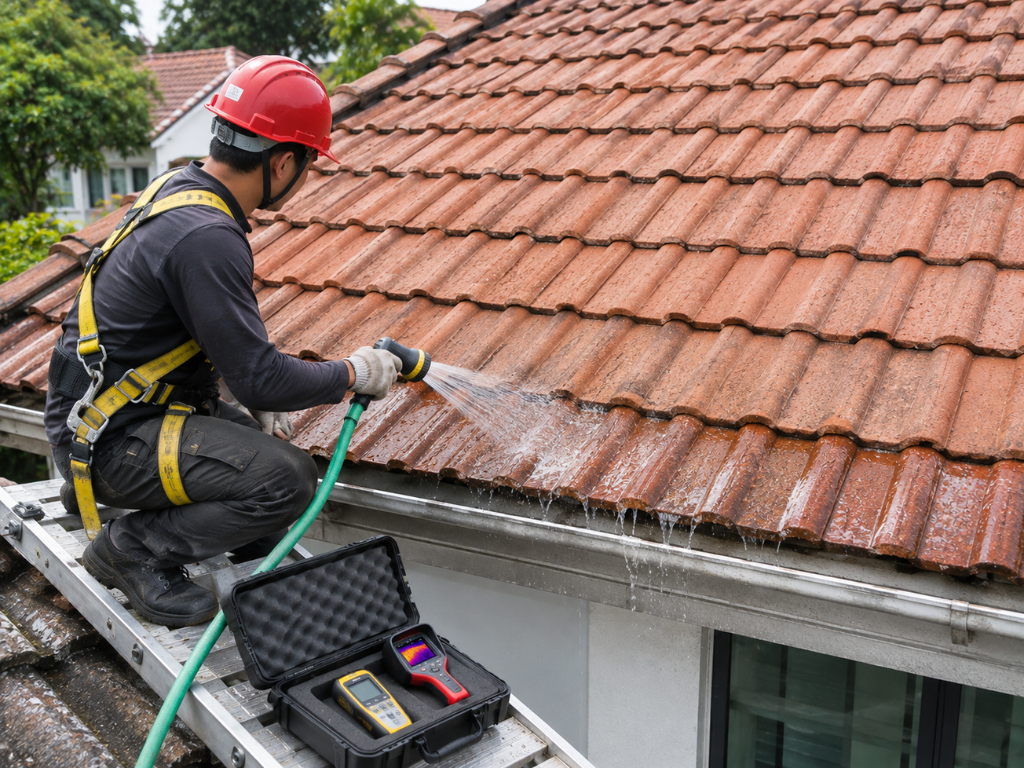
Roof leak detection in Singapore means proving where water gets in before anyone repairs the roof, using stain mapping, moisture readings and a controlled water or flood test. It matters most after a patch that didn’t hold, or when an MCST and an owner disagree about the source. Proof-Tech inspects and repairs roof leaks on condominiums, commercial buildings and landed houses in Singapore, and our roof leakage repair service page lists the roof leak work we cover.
How does roof leak detection in Singapore work?
A proper investigation narrows the source down in stages, from the cheapest evidence to the most certain, and only then prices a repair. Skipping straight to the roof with a tube of sealant is how owners end up paying twice.
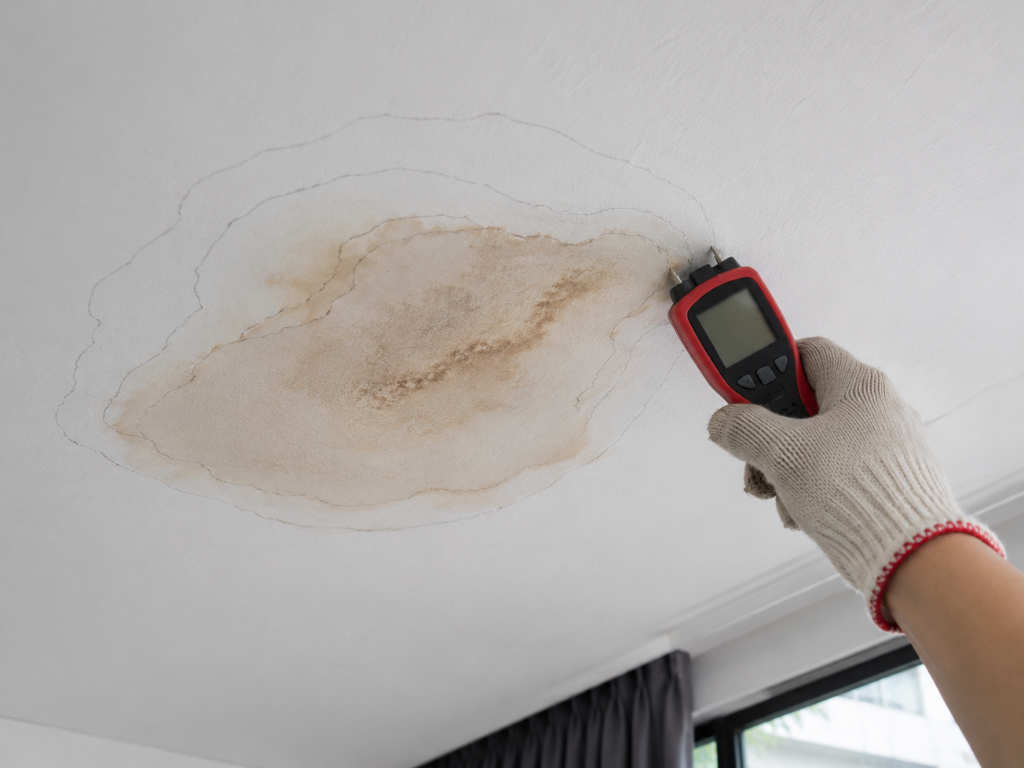
It starts below the roof, with the history and the stain. When did it first appear, does it show during rain or after, and does it grow in a storm with wind from one side? Ceiling stain mapping means marking the edge of the stain with the date after each wet spell. It shows whether the leak is active and which way the water is travelling.
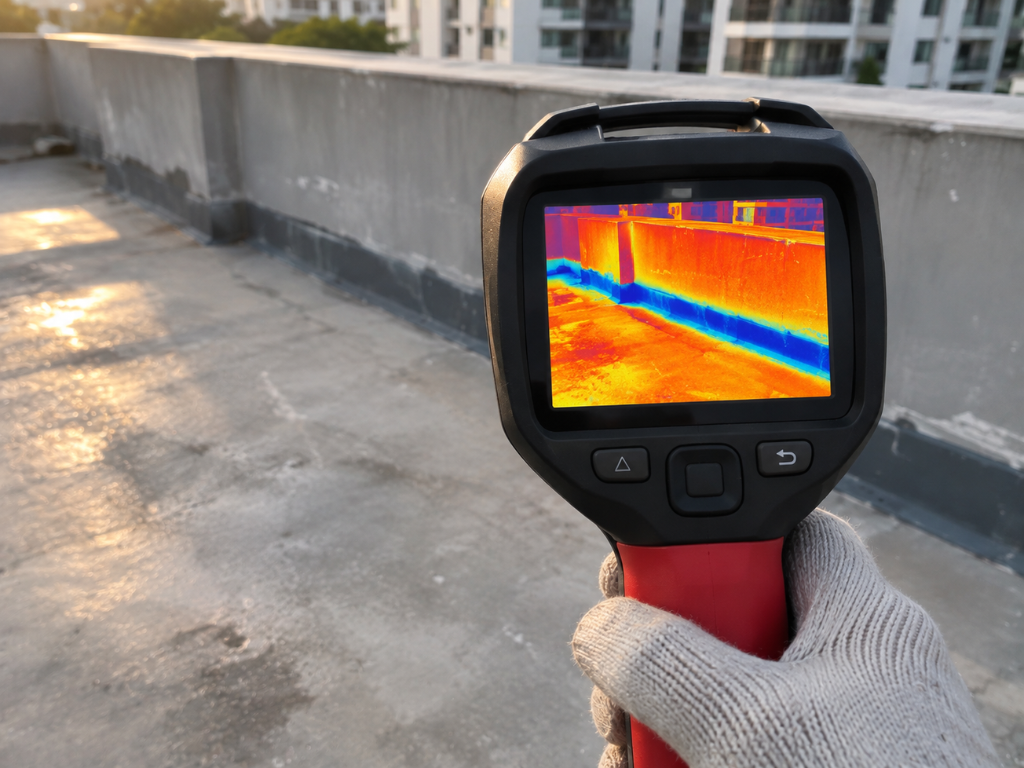
Next come the readings. A moisture meter maps how far the wet patch spreads beyond what you can see. A thermal camera shows cool, damp areas behind the ceiling or across the roof. Both point to where to test. Neither proves the entry point.
The proof comes from a controlled test on the roof itself while someone watches the ceiling below. That means a flood test on a flat roof, or a water test on a pitched or metal roof. Then the findings go into a written investigation report, and the repair is priced against what the test showed.
Is it a roof leak or a pipe leak?
Timing usually tells you. A roof leak shows up during rain or soon after, and dries out between storms. A pipe leak keeps going on dry days, because water runs through the pipe whether it rains or not.
These signs point away from the roof:
- the ceiling is wet on dry days, or gets worse after showers and flushing upstairs
- the stain sits under a bathroom, kitchen or aircon unit rather than an outside edge
- your water meter keeps turning with every tap in the house shut
- water drips steadily at night when nobody is using water
If the toilet or bathroom above is the source, the testing is different. Our article on how a toilet leak to the unit below is traced covers it. On a top-floor unit or a landed house, check the aircon drain pipes and the water tank overflow before anyone opens the roof. A leaking condensate pipe can look exactly like a roof leak.
What does each leak detection method tell you?
Each method answers a different question, so a good investigation uses them together and in order. A report built on one thermal photo is a guess with a picture attached.
| Method | What it shows | What it cannot tell you | When to use it |
| Ceiling stain mapping | Whether the leak is active, and which way water travels | Where the water enters the roof | From the first stain, every wet spell |
| Moisture meter | How far the damp spreads behind paint and plaster | Whether the damp is old or still being fed, without repeat readings | To size the wet zone, then again a week later |
| Thermal camera | Cool, damp areas on a ceiling or roof slab | The entry point itself; sun, shade and aircon create false patches | To choose where to test, ideally after a sunny day |
| Water test (pitched or metal roof) | Which section of roof lets water in | Anything, if it is rushed or done top-down | Before any repair on tiles or metal sheets |
| Flood test (flat RC roof) | Whether the membrane holds water over a set time | Which detail failed, unless the test is staged | Before and after repair on a flat roof |
The meter reading a week apart matters more than people expect. A ceiling that reads wetter after a dry week is still being fed. One that reads drier is drying out, and the leak may already have stopped or moved.
How is a flood test on a roof carried out?
A flood test on a flat roof means plugging the drain outlets and covering the slab with a shallow layer of water. It stays there for at least 24 hours while someone checks the ceiling below. If the ceiling stays dry, the membrane holds at that water level.
A staged flood test tells you more than a single fill. It starts with low water that covers the open slab but not the upturns (the membrane turned up the parapet wall). If the ceiling stays dry, the level goes up to reach the upturns, and the outlets are tested on their own.
Whichever stage wets the ceiling shows which detail failed. The repair then targets that detail instead of the whole roof.
Pitched and metal roofs cannot hold water, so they get a water test instead. Water is run over one section at a time, starting at the bottom edge and working up, with each section given time before moving on. Testing from the top down soaks everything below at once and points at the wrong spot.
Protect the room below before any test. A roof that is already leaking will leak during the test, which is the point, so furniture and electrics need moving first.
Who should arrange roof leak detection in a condo?
In a condominium, the MCST arranges it when the roof is common property. BCA’s water seepage guide for strata owners (Guide 13) sets out how to start. Owners under the roof should first check the strata title plan, because in cluster houses and some shophouses the roof belongs to the unit.
The guide suggests a joint inspection with the affected owners and the MCST or managing agent, so everyone sees the same evidence at the same time. Parties can also bring in an independent consultant to find the cause. Push for one coordinated investigation instead of two contractors writing two reports that disagree.
If you own a landed house, you arrange detection yourself. In a commercial building, it goes through the management corporation or building manager. Our article on who pays for condo leaks covers what happens when the MCST does not act.
What should a leak detection specialist’s report tell you?
A useful report names the source, shows the test that proved it and lists what was ruled out. Whether you hire a leak detection specialist or a water leak detection contractor in Singapore who also repairs, hold the report to the same standard.
It should include dated photos of the stain and the roof, and moisture readings with their locations. Each test should be listed with its start time, end time and result. Then it should give a repair scope tied to the finding: one upturn, one outlet, or membrane failure across the roof if the tests show that.
Be wary of a report that blames “membrane failure” across the whole roof with no test behind it. The same goes for one that leads straight to a full re-waterproofing quote. A slab crack under one corner and a membrane worn out everywhere need very different budgets, and only testing tells them apart.
For a straight answer on your leak, we need dated photos of the stain taken during rain and a photo of the roof above it. Add the times the leak shows up and any earlier repair invoice. If the leak has spread into the ceiling, our ceiling leakage repair work covers the inside once the source is fixed.
How long does roof leak detection in Singapore take, and what does it cost?
The site survey and readings take a few hours, but a full investigation runs over several days. A flood test needs at least a day per stage, and moisture readings need a week between them to show a trend.
Expect roughly $300 to $1,000 for a home, with a written report. Where you land depends on the roof type, how many tests are needed and how easy the roof is to reach. Large commercial roofs are priced on area and access. The investigation is usually quoted separately from the repair, and that is a good sign, because it means the repair scope waits for the evidence.
Conclusion
Don’t pay for a roof repair until someone has proved where the water gets in. Ask for stain mapping, readings and a controlled water or flood test, and a written report that names what was ruled out.
To confirm what your roof needs, we need dated photos of the stain during rain and a photo of the roof above it, plus when the leak shows up. Send them through our enquiry form for a no-obligation quote, or call +65 6100 7558.
Frequently asked questions
Can I find the roof leak myself?
You can gather the evidence, but leave the testing to someone with the right access. Photograph the stain during rain, note the times and mark its edge with the date. Climbing a wet roof is dangerous, and a hose test done in the wrong order points at the wrong spot.
Will leak detection damage my ceiling or roof?
The readings and water tests leave no marks. Sometimes the investigator needs to open a ceiling access panel or cut a small inspection opening to see the slab or pipes. Ask beforehand whether any opening is planned and who makes it good afterwards.
Does Proof-Tech repair the roof once the source is found?
Yes. Proof-Tech repairs roof leaks, re-waterproofs roofs and repairs tile roofs once the source is confirmed. If your MCST has already engaged an independent consultant, send us their report. We’ll quote the repair scope it sets out, so the fix matches the finding.
Should I call while it is still raining?
Yes, if you can. An active leak is far easier to trace than a dry stain, and photos taken during the rain are the best evidence you will have. Call during or right after the storm, and don’t repaint the ceiling until the source is found.