

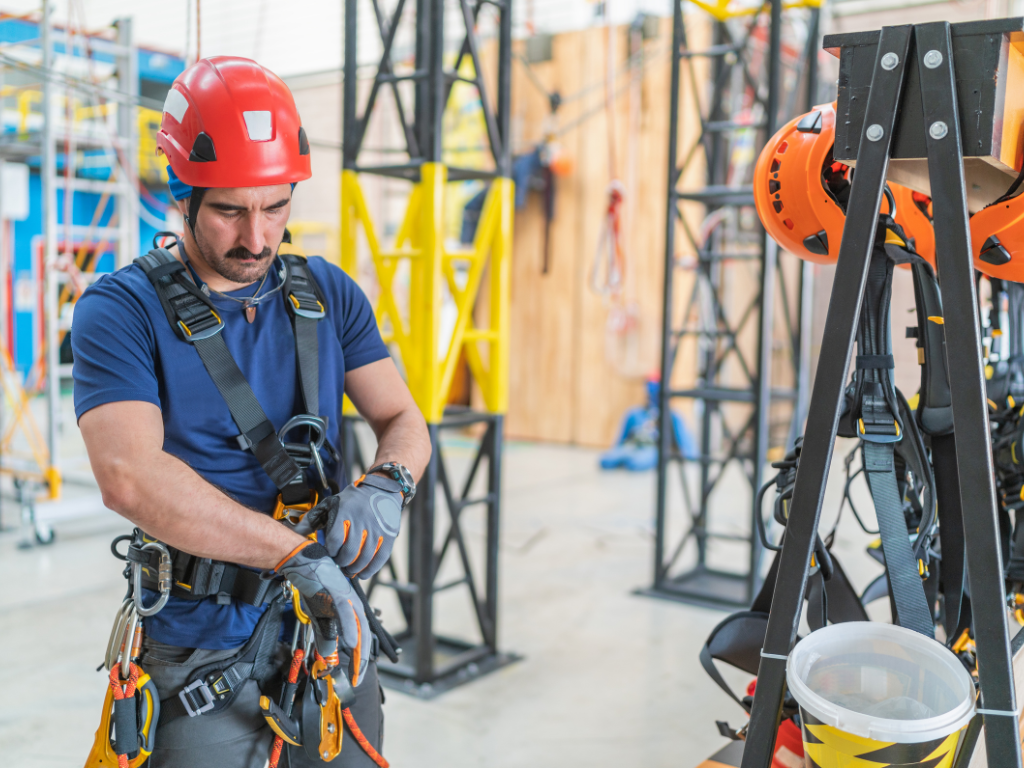
Facade inspection methods in Singapore split into two jobs the law treats separately: a visual survey of the whole facade, and a hands-on check of at least 10% of every elevation. Drones handle the first. Gondolas and rope access handle the second. Since May 2025, BCA lets Competent Persons fly accredited drones without case-by-case approval. This blog walks you through each method alongside periodic facade inspection support.
What methods does a facade inspection in Singapore actually use?
Every Periodic Facade Inspection has two mandatory stages. A visual survey covers 100% of the facade, and a close-range inspection with physical contact covers at least 10% of the surface area of each elevation.
Regulation 15 of the PFI Regulations 2021 sets both. The visual survey is carried out from ground level or other vantage points using photographic cameras, or with equipment the Commissioner of Building Control approves, such as a drone. The close-range inspection is carried out along vertical drops or trails from the top floor to the ground floor, using a tapping rod, rubber mallet, borescope or simple scanning equipment.
That wording shapes every access decision. A vertical drop needs something that moves a person up and down the facade. BCA’s Guidelines name the gondola first, then mast climbers, scissor lifts, boom lifts, building maintenance units and motorised elevated work platforms where a gondola is not feasible. Rope access is the other common choice, used under the Competent Person’s discretion to pick an appropriate access mode.
Some technology needs the Commissioner’s prior approval before it counts: robotic automated tapping devices, automated scanning equipment, and infrared or ultrasound scanners. A full facade investigation, with panel removal and laboratory tests, is a separate third stage that also needs approval.
Can a drone inspection replace the hands-on tap test?
No. Regulation 15(2)(b) directs the close-range inspection towards defects beneath the facade surface, such as hollowness or corrosion of concealed connections, and a camera cannot detect either.
BCA’s FAQ is explicit on the nearest substitute. Infrared thermography supplements close-range inspection, so Competent Persons must still carry out the 10% close-range check, and they need the Commissioner’s approval before using thermography at all.
Where this breaks down is the quotation that promises a complete PFI with “no rope access, no gondola”. At least one drone provider ranking on Google for facade inspection makes that claim today. A report built that way leaves the 10% close-range requirement unmet, and the Competent Person, who faces fines of up to $50,000 under section 28(10) of the Building Control Act for failing to inspect in the prescribed manner, carries that risk.
Drones earn their place in the first stage. A drone captures a full, geo-tagged photographic record of every elevation, which a team with binoculars and a telephoto lens struggles to match on a 30-storey block. That record tells the Competent Person where to send the close-range drops.
The cleaner approach combines both: a drone survey for 100% coverage, then gondola or rope access drops aimed at what the drone found.
How does a drone facade survey work under BCA and CAAS rules?
A drone survey counts towards the visual inspection when an accredited drone service provider flies it. The Competent Person must notify the Commissioner of Building Control before the flight, and the Competent Person or a facade inspector must be present while it happens.
The approval is recent. The Singapore Accreditation Council opened accreditation for building facade inspection using drones on 12 July 2023. On 23 May 2025, BCA’s circular on accredited drone providers granted blanket approval for accredited providers. Non-accredited operators still need the Commissioner’s written approval for each use.
Accreditation audits the parts owners rarely see. Providers are assessed on pilot training, approved equipment and software, AI performance in detecting defects and anonymising residents, data protection, and record traceability. The Competent Person must still personally review every photograph the drone produces, under regulation 16(3).
Aviation rules sit on top. CAAS requires a Class 1 Activity Permit for all outdoor drone flights for business purposes, and that permit needs a valid Operator Permit. Within 5 km of an aerodrome, CAAS can require de-confliction from manned flights and a power-tethered drone.
Cost scales differently from manual methods. Dr Yuan, Principal Engineer of Visual Analytics at TÜV SÜD, said in a case study published by Singapore’s Open Innovation Network that with drones “the effort only scales with the façade size”, whereas complex architecture pushes conventional inspection costs higher.
When does a gondola make sense for facade inspection?
A gondola makes sense on long, flat elevations, and on any building that already has a permanent building maintenance unit. It gives the facade inspector a stable platform for tools and lets two people inspect a wide strip in one descent.
Buildings with a permanent gondola or building maintenance unit, common on office towers with curtain walls, start with an advantage. The equipment is already installed on that facade, and close-range drops follow the tracks it runs on.
Temporary gondolas are a different proposition on older buildings. MOM’s circular of 10 January 2025 on outriggers for suspended scaffolds requires a Professional Engineer to design every outrigger or overhead support, with guidance from SS 598:2014. The PE must verify the roof can take the load, using approved and as-built drawings, and order concrete core tests or non-destructive tests where drawings are missing.
Two conditions in that circular rule out quick setups on many 20-year-old condominiums. Outriggers cannot sit on brick or block parapet walls, thin walls with a single layer of reinforcement, or sloping parapets, unless the PE has verified their strength. Tie-backs must anchor to roof beams or internal columns, and never to solar panels or M&E installations.
Worth noting: a gondola rigged for inspection can stay for the Repair and Redecoration works that follow. BCA encourages owners to schedule R&R around the PFI for exactly that saving.
Is rope access acceptable for close-range facade inspection?
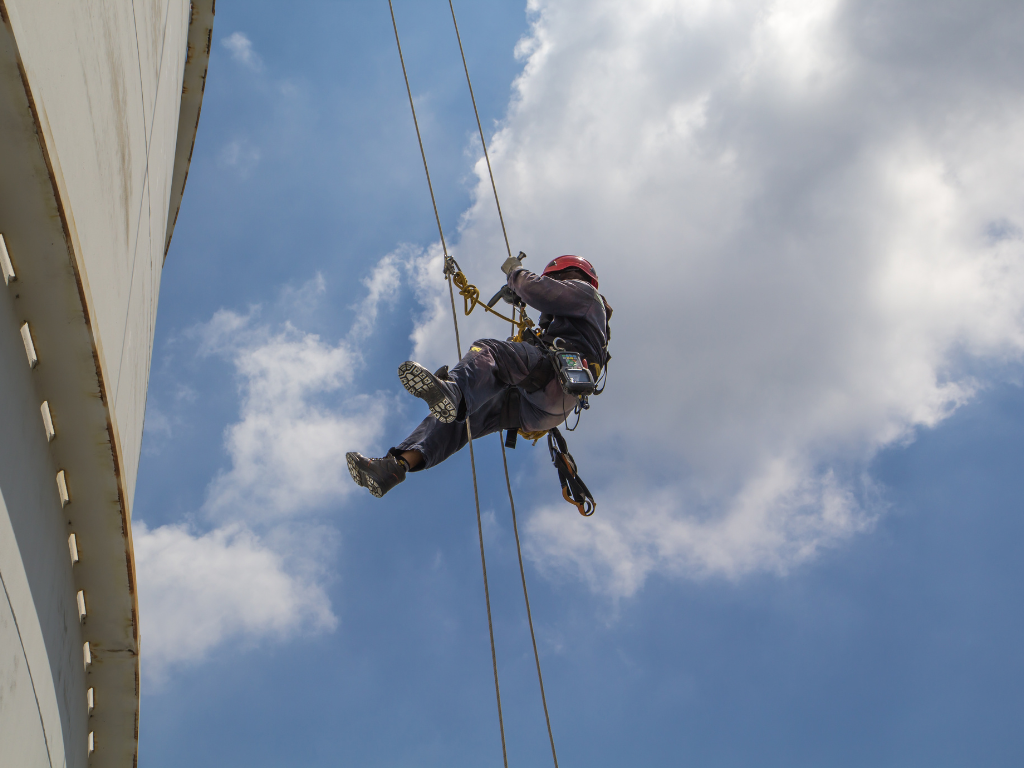
Yes. Rope access gives the facade inspector a vertical drop from roof to ground, which matches how regulation 15(4) describes close-range inspection. It is widely used for PFI close-range work, under the Competent Person’s discretion to choose an appropriate access method and subject to MOM’s work-at-height rules.
Rope access has its own Singapore Standard. SS 588:2013, in two parts, is a modified adoption of ISO 22846-1:2003 and sets out the system of work and code of practice. Enterprise Singapore’s standards work programme lists it for revision in the second half of 2027. Across the industry, technicians certify through IRATA International at three levels, with a Level 3 technician supervising the rope system on site.
Rope access wins where a gondola struggles. Rigging needs secure anchor points rather than PE-designed outriggers, so brick parapets and cluttered roofs are less of an obstacle. A technician can move sideways into recessed bays, work under canopies and around air-conditioner ledges, and re-rig for the next drop without relocating outriggers.
The trade-off is payload. One person on a rope carries a tapping rod, borescope and camera, not a platform of equipment, and every hole or sample for a full facade investigation is slower from a harness.
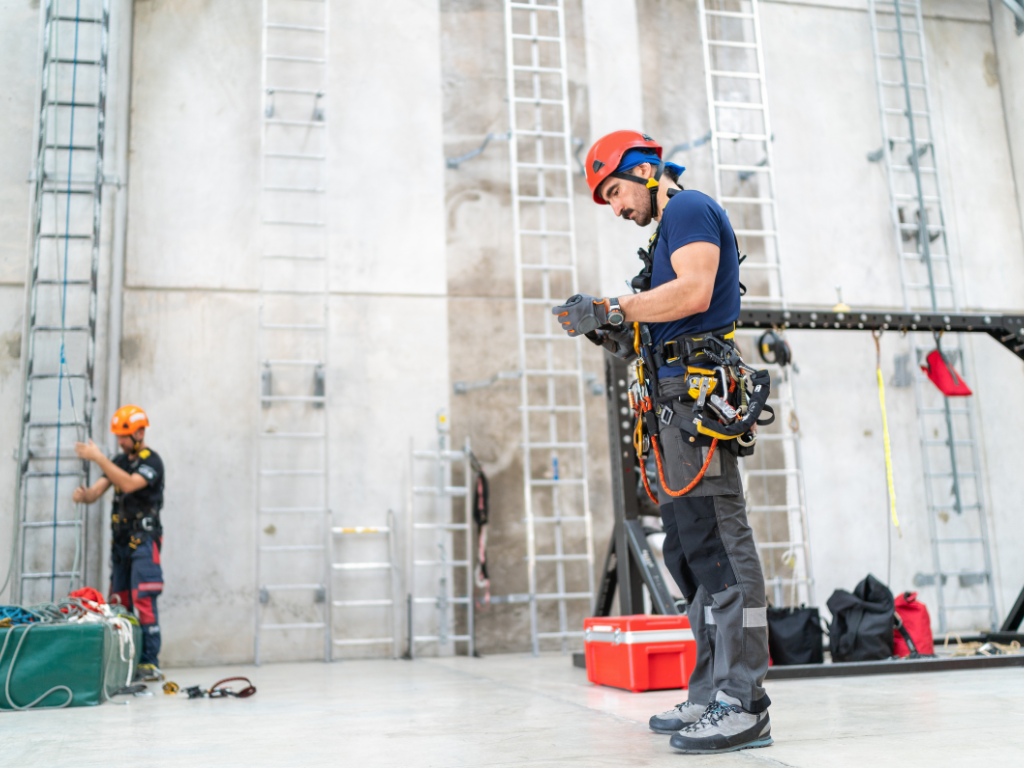
Safety planning is not optional. Falls from height caused 43 fatal and major injuries in Singapore’s construction sector in 2025, the leading higher-risk cause in that sector according to MOM’s Workplace Safety and Health Report 2025. Before anyone goes over the edge, ask the contractor handling rope access works for a written fall prevention plan and a named rope access supervisor.
Who is allowed to do the tapping on the rope or in the gondola?
The Competent Person, or a facade inspector under the Competent Person’s direct supervision and control. A rope access technician or gondola operator who is neither provides the access, not the inspection.
Regulation 16 makes close-range inspection a personal duty of the Competent Person, which can be discharged through a facade inspector using the tapping and borescope methods in regulation 15(4). BCA’s FAQ adds that even testing laboratories engaged for close-range work need prior approval, and the Competent Person or facade inspector must attend.
Since 1 October 2025, regulation 16A bars a facade inspector who is a partner, officer or employee of the building owner, the original builder, or anyone involved in building works on the facade. Regulation 16B requires the facade inspector to personally supervise anyone operating approved inspection equipment.
In practice, this separates two contracts. The access contractor rigs the ropes or gondola, supplies the supervisor and manages work-at-height safety. The facade inspector, trained for rope access where ropes are used, goes down the drop and does the tapping. Our position: if the access firm expects to bid for the repairs, it should not also supply the facade inspector.
What does the close-range tap test find, and how are defects recorded?
The tap test finds hollowness. A tapping rod or rubber mallet produces a dull, drummy sound over debonded render or delaminated tiles, which look intact to a camera until they fall. A borescope pushed behind cladding panels checks brackets and fixings for corrosion.
Singapore’s climate makes this more than a formality. The NUS study published in BCA’s Guidelines V1.3 found tile adhesive service life can fall to 10 years under projected climate stress, and a hollow tile looks intact to a camera. Our tropical climate maintenance guide covers how moisture attacks facades here, and cracked render can also signal water damage behind facades as well.
Records follow a set pattern. BCA’s Guidelines require the Competent Person to log the date, time and location of every defect, and the report must include drawings marking the 10% areas inspected and colour photographs of every segment classified “Require Repair” or “Unsafe”. A practical format is the elevation map: the drone’s photo mosaic with drop lines and defect pins overlaid.
Drop selection is deliberate. The Guidelines ask for areas above heavy foot traffic and areas the drone flagged, and for locations different from the previous cycle where possible. Defects found become the remedial scope, typically concrete spalling repairs, render reinstatement and sealant replacement.
Rope access, drone or gondola: how do the facade inspection methods compare?
Drones win the visual survey. Gondolas and rope access split the close-range work, and the building’s geometry decides between them.
| Factor | Drone (accredited UAS) | Gondola (suspended scaffold) | Rope access |
| PFI stage it can satisfy | 100% visual survey | Close-range 10% drops | Close-range 10% drops |
| Tactile tap test | Not possible | Yes | Yes |
| Key rules | CBC notification, SAC accreditation, TR 78-1:2020, CAAS Class 1 Activity Permit | WSH (Scaffolds) Regulations, SS 598:2014, PE-designed outriggers (MOM circular 2025-02) | WSH (Work at Heights) Regulations, SS 588:2013, IRATA certification in practice |
| Roof requirements | Take-off space only | Load-verified roof, no masonry parapets without PE check | Rated anchor points |
| Handles recesses, canopies, ledges | Sees them, cannot touch | Poorly | Well |
| Crew and payload | Pilot plus CP or FI present | 2 people plus tools on a platform | 1 person per rope, hand tools |
| Occupant notice | At least 3 days under TR 78 | Advance notice under BCA Guidelines | Advance notice under BCA Guidelines |
| Reuse for repairs | No | Yes, for R&R | Yes, for localised repairs |
The table hides one practical point. Boom lifts and scissor lifts handle close-range work on low-rise blocks with clear ground access, and they need neither roof anchors nor rope certification.
Which facade inspection method fits which building?
Match the method to the facade, not to the provider’s fleet. Most Singapore PFIs end up combining a drone survey with one close-range method.
Condominium slab blocks with balconies, planter boxes and air-conditioner ledges suit a drone survey plus rope access drops. Projections interrupt a gondola’s vertical travel, while a rope technician steps around them.
Office towers with a permanent building maintenance unit should use it. The cradle already runs the full height of the curtain wall, and the drone survey confirms which bays need attention.
Low industrial blocks and older shophouse-style commercial buildings just above 13 metres can skip suspended access entirely. A boom lift from the car park covers the drops, and a drone or ground cameras cover the survey.
Buildings within 5 kilometres of an aerodrome or airbase, such as Changi Airport, Paya Lebar Air Base or Seletar Airport, face extra CAAS conditions on drone flights. Plan for longer permit lead times or a ground-based camera survey.
Older buildings with brick parapets and no structural drawings push temporary gondolas into PE verification and core testing. There, rope access in Singapore construction gets the facade inspector onto the wall with far less roof work.
Conclusion
The two stages of a facade inspection call for different tools, and treating them as one decision is where budgets and compliance go wrong. Drones give the Competent Person full visual coverage. The 10% tap test still needs a person on a drop, and roof condition, facade projections and the repair plan decide whether that person hangs from a gondola or a rope.
Send Proof-Tech your building’s elevations, roof photos and PFI notice for a rope access plan that gets your Competent Person’s close-range drops done safely, and carries straight into the remedial works that follow.
Frequently asked questions
Can infrared thermography be used for facade inspection in Singapore?
Yes, as a supplement only. BCA’s PFI FAQ states infrared thermography helps identify underlying defects, but Competent Persons must still complete the 10% close-range inspection on each elevation. Thermography, robotic tapping devices and ultrasound scanners all need the Commissioner of Building Control’s prior approval under the PFI Regulations 2021.
Do residents get notified before a drone facade inspection?
Yes. Technical Reference TR 78:2020, cited in BCA’s PFI FAQ, sets out at least 3 days’ advance notice to building occupants with inspection details. Operators must also comply with the Personal Data Protection Act, and BCA’s accreditation audits how providers anonymise residents captured in images and prevent unauthorised use of footage.
Can boom lifts be used for close range facade inspection?
Yes. BCA’s PFI Guidelines list boom lifts, scissor lifts, mast climbers, building maintenance units and motorised elevated work platforms as access options when a gondola is not feasible. Operators must hold the relevant machinery certification, and all access platforms must meet Ministry of Manpower work-at-height requirements.