

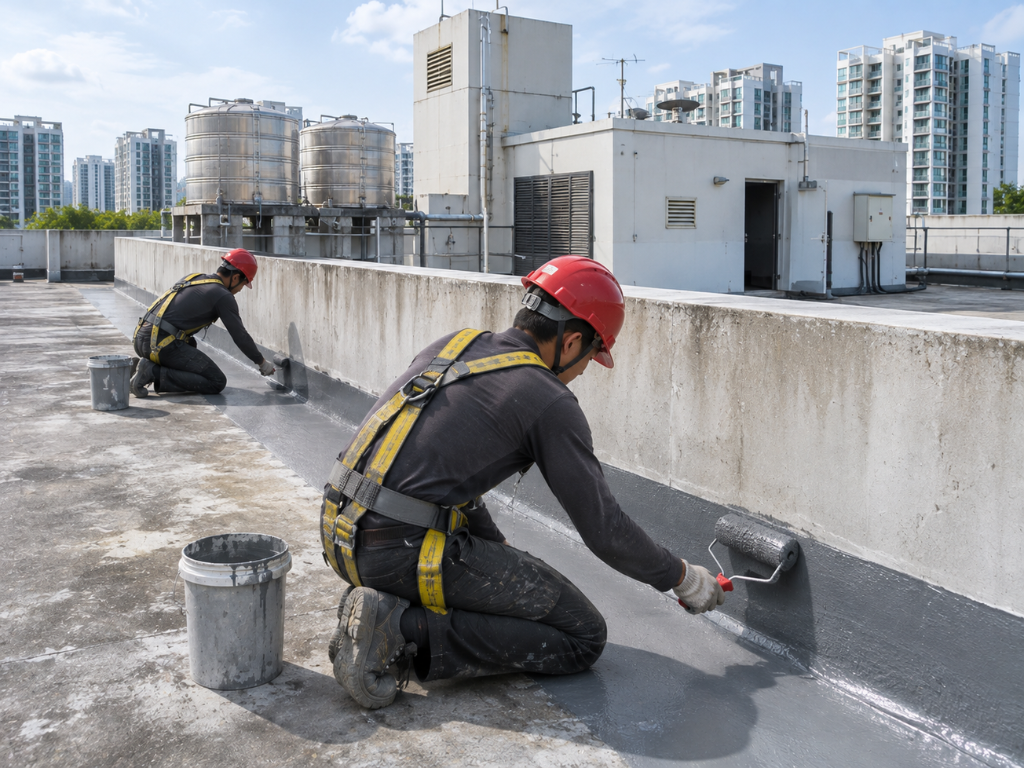
Condo roof leakage repair is the MCST’s job whenever the roof is common property, which covers the main roof and its waterproofing in a typical condominium. That matters for top-floor and penthouse owners waiting on a fix, and for council members who have to scope and pay for one. Proof-Tech repairs roof leaks on condominiums in Singapore, and our roof leakage repair service page lists the roof work we take on.
Is a condo roof common property, and must the MCST fix it?
Yes, in a standard condominium the roof is common property, so the MCST must maintain and repair it. BCA’s strata living guide (SMG1) lists a building’s roof and its waterproofing membrane as examples of common property. The law behind it is the Building (Strata Management) Act, still widely called the BMSMA.
That means the MCST pays for the repair from the funds every owner contributes to, through the managing agent it appoints. The top-floor owner whose ceiling is wet does not pay for the roof just because the water lands in their unit.
The exception is a roof that sits inside a lot. In cluster houses and some strata shophouses, each unit can own its own roof. The strata title plan, which shows each unit’s boundary, settles which case you are in, so get a copy before anyone argues about money.
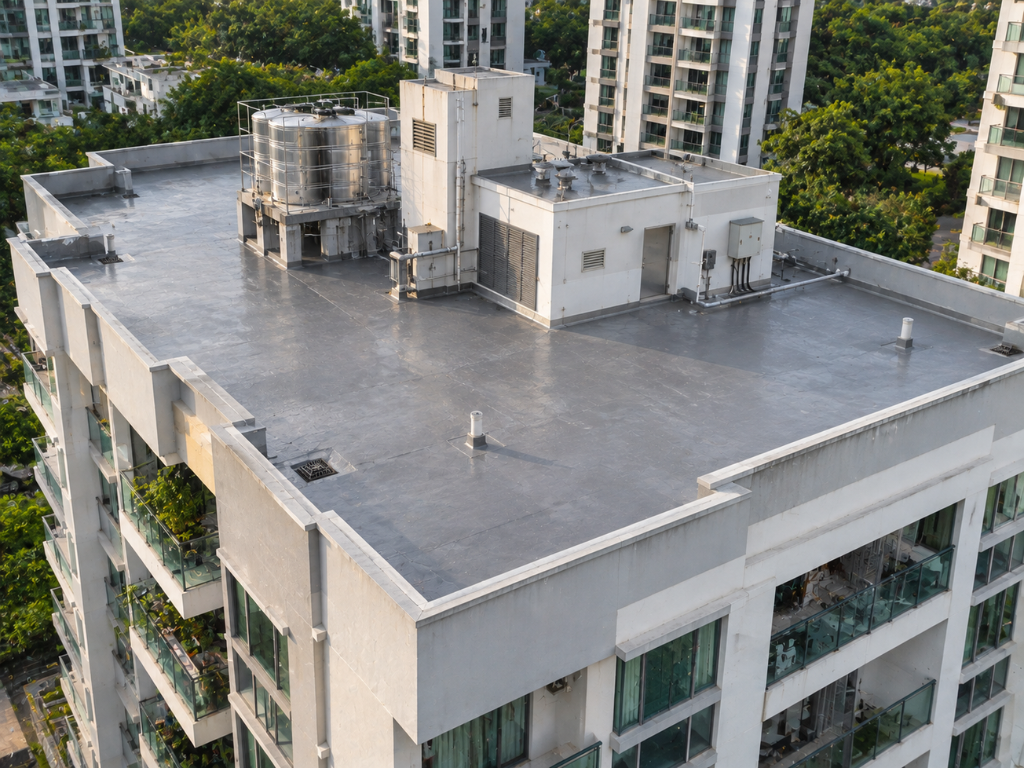
Penthouse roof leak: who pays?
For a penthouse, who pays turns on which roof is leaking. A penthouse often has two: the building’s main roof over it, and its own roof terrace.
If the main roof leaks, the MCST pays, because that roof serves the building. The High Court has ruled that a roof outside an owner’s strata boundary is common property even when only that owner can reach it. Check your by-laws too, because a by-law giving you exclusive use of an area can also put its upkeep on you.
If the leak comes from a roof terrace inside your strata lot, the terrace waterproofing is yours to repair. And if that terrace leaks into the unit below, the presumption runs against you as the owner above, so get it tested early.
The roof repair and the damage inside your unit are separate questions. BCA’s water seepage guide (Guide 13) treats compensation for damaged ceilings and furniture as a matter to settle between the parties. The Strata Titles Board is the fallback if you can’t agree.
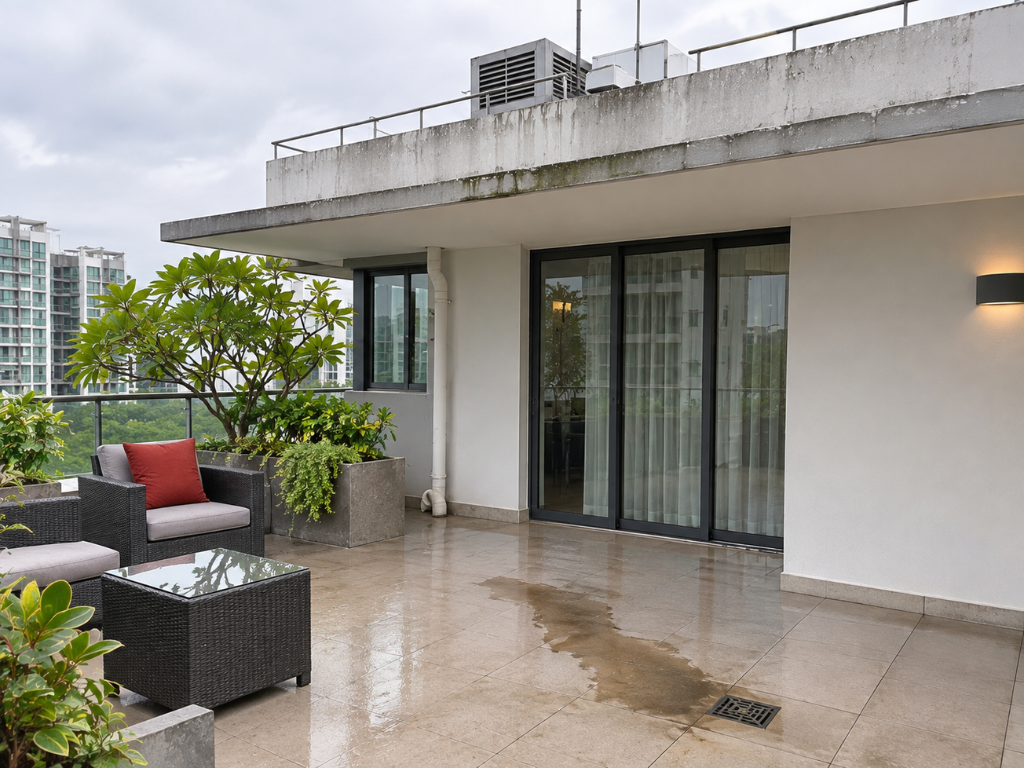
How should the MCST scope condo roof leakage repair?
Scope it from evidence, not from the first quote that comes in. A good scope follows a set order. Skipping steps is how estates pay for a whole new roof when one upturn failed, or keep patching a roof that needed redoing.
First, prove the source. Hold a joint inspection with the affected owners and the managing agent. Then have the leak tested with a flood test or water test before anyone prices a repair. The result tells you whether you are fixing one detail or a membrane that has failed across the roof.
Next, decide which fund pays. A localised repair sits in the management fund, which covers day-to-day repairs of common areas. Re-waterproofing the whole roof is long-term, cyclical work, so it usually comes from the sinking fund. If the spend was not in this year’s budget, or the sinking fund is short and a special levy is needed, ask the managing agent early about general meeting approval. That step can add weeks.
To scope your roof properly, we need the strata roof plan and photos of the roof and the stained ceilings. Add the leak log with dates, and when the roof was last waterproofed and with what. With those, we can tell the council whether a targeted repair will hold or the roof needs waterproofing works across the whole area.
What should the quotation scope for a condo roof include?
Send every contractor the same written scope, so the quotes can be compared line by line. A quotation scope that leaves gaps lets each contractor price a different job, and the cheapest quote often has the most left out.
| Scope item | Why it matters |
| Roof plan with areas and leak points marked | Every contractor prices the same roof |
| Investigation findings and the test that proved them | The repair targets the proven source |
| Strip the old system or lay over it, and how much | The biggest price swing; a new layer over a wet one fails |
| Details: upturns, outlets, parapets, plinths, pipe and bracket holes | Where repeat leaks start |
| The waterproofing system, named, with its protection layer | You compare like with like |
| Access and protection for top-floor units | Hidden cost and resident disruption |
| Method statement (how the work is done, in order, safely) | Shows the contractor has planned the job |
| Works schedule with a wet-weather allowance | Monsoon delays are planned, not argued over |
| Flood test before handover | Proof before final payment |
| Warranty: length, what it covers, who signs it | Workmanship and material cover differ |
| Payment stages, with a sum held back until the roof stays dry | Money follows results |
| Ceiling reinstatement in affected units | Agreed upfront, done after the roof is proven dry |
The warranty line deserves the most care. Our guide to waterproofing warranties explains what a sound one covers and which exclusions to push back on.
How do you choose condo roof leakage repair companies in Singapore?
Pick on the quality of the scope and the method statement, then on price. Two contractors quoting the same written scope are easy to compare. A contractor who rewrites your scope to suit their price is quoting a smaller job.
Check that the contractor is BCA-registered for waterproofing work and carries insurance for working at height. Ask how they will reach the roof safely: by staircase, scaffold or rope access. Ask for condominium roof jobs they have done and the warranty they gave on them. Our 12 checks for choosing a contractor cover the registration and warranty questions in detail.
Treat these as red flags:
- a quote with no investigation behind it, or one that skips the flood test
- “overlay” with no plan for the wet membrane underneath
- no method statement or works schedule
- a warranty that covers only material, or only the patched area
- full payment before handover
What happens during the works and at handover?
The managing agent should notify residents before the works start, with the dates, working hours and any access needed to top-floor units. Noisy work has to fit the hours your by-laws allow, so build that into the schedule.
On site, the contractor should photograph each stage, from stripping to the details to the finished membrane. Those photos are what a later warranty claim rests on. The flood test happens before the protection layer goes on, while a failure is still cheap to fix.
At handover, the MCST should receive the test record, the stage photos, the product data and the signed warranty. Only after the affected ceilings have stayed dry through real rain should they be repaired and repainted.
Conclusion
If the roof is common property, the MCST has to fix it, so top-floor owners should report the leak in writing and push for a tested source. Councils should scope from that evidence, send one written scope to every contractor and pay only once a flood test passes.
To scope your roof, we need the strata roof plan, photos of the roof and stained ceilings, the leak log and the last waterproofing record. Send them through our enquiry form for a no-obligation quote, or call +65 6100 7558.
Frequently asked questions
I’m a top-floor owner with a roof leak. What should I do first?
Report it to the managing agent in writing the same day, with dated photos taken during rain, and ask for a joint inspection. Keep copies of everything you send. If the MCST does not act, our article on who pays for condo leaks covers your next steps.
Can the MCST charge me for the roof repair?
Not for repairing common property, which comes from the estate’s funds. It can recover costs if your own works caused the damage, for example drilling through the roof membrane to fix aircon brackets or solar panels. Get the MCST’s approval before any work that touches the roof.
How long does a condo roof re-waterproofing take?
A localised repair can be done in a few days once access is set up. Re-waterproofing a whole condominium roof usually takes several weeks, depending on the area, whether the old system is stripped and how much rain falls. Ask for a works schedule with a wet-weather allowance before you sign.
Does Proof-Tech work on condominium roofs?
Yes. Proof-Tech repairs roof leaks and re-waterproofs roofs on condominiums and commercial buildings, and is BCA-registered for waterproofing installation (CR13). We also carry out rope access works where a roof edge or facade cannot be reached safely from inside.