


How to choose a waterproofing contractor in Singapore comes down to verifiable credentials and a tested method rather than the lowest quotation. BCA’s directory listed 450 firms under the CR13 waterproofing workhead in September 2026, spread across grades L1 to L5. This blog walks you through 12 checks to run before signing, starting with the waterproofing systems for buildings you are buying.
What should you check before appointing a waterproofing contractor?
Run 12 checks across three areas: credentials you can verify, a method you can read, and evidence you will receive at handover. Anything a contractor cannot show you on paper before the job is unlikely to appear after it.
| # | Check | What to ask for |
| 1 | BCA CR13 registration and grade | Company name and UEN, verified in BCA’s directory |
| 2 | SCI Waterproofing Accreditation grade | Current W1 to W4 certificate |
| 3 | Safety credential | bizSAFE Level 3 or ISO 45001 certificate |
| 4 | Track record on your building type | Two comparable projects with contact references |
| 5 | Site survey before quotation | Written findings on the leak source, not a phone estimate |
| 6 | Method statement referencing SS 637:2018 | Sequence, substrate preparation, detailing at upstands and outlets |
| 7 | Named products | Manufacturer, product name and technical data sheets |
| 8 | Supervisor and worker certification | Certificate in Waterproofing Supervision; worker certificates or CORETRADE |
| 9 | Inspection and test plan | Hold points, plus a 24-hour ponding test with records |
| 10 | Warranty in writing | Years, scope, exclusions, and whether contractor or manufacturer honours it |
| 11 | Access, safety and permits | Gondola or rope access plan, MCST permit, hoarding, work-at-height controls |
| 12 | Payment milestones | Staged payments tied to the passed test and a defects liability period |
Checks 1 to 4 take 15 minutes online. Checks 5 to 12 shape the contract, and they separate a specialist from a general renovation outfit that subcontracts membrane work.
Failure rates justify the effort. Michael Chew of the National University of Singapore and his co-authors reported in Buildings that “waterproofing defects were discovered in 59% of the buildings” they studied in the tropics.
What does BCA CR13 registration actually mean?
CR13 is BCA’s Waterproofing Installation workhead, covering waterproofing of basements, roofs and walls. Registration shows a firm met financial, track record and personnel requirements at a stated grade; it is a register used for public sector tendering, not a trade licence.
The grades tell you about size, not skill. Under BCA’s May 2025 registration requirements, L1 needs $10,000 paid-up capital and $100,000 of track record over three years, L3 needs $150,000 and $3 million, L5 needs $500,000 and $10 million, and L6 needs $1.5 million and $30 million. From L2 upwards, firms must also hold bizSAFE Level 3 or ISO 45001.
The market is concentrated at the bottom. BCA’s directory on 16 September 2026 listed 450 CR13 firms: 368 at L1, 31 at L2, 25 at L3, 8 at L4 and 18 at L5.
Verification takes two minutes. Search the company’s exact registered name or UEN in BCA’s directory, check the workhead, the grade and the expiry date, and compare the entity name with the one on the quotation. A quotation issued by a different company from the registered one is a problem worth raising before works start.
Worth noting: Proof-Tech Waterproofing & Maintenance Pte. Ltd. (UEN 201026889N) appears in that directory under CR13 at grade L3, one of the 25 firms at that grade.
What is SCI waterproofing accreditation, and does it matter?
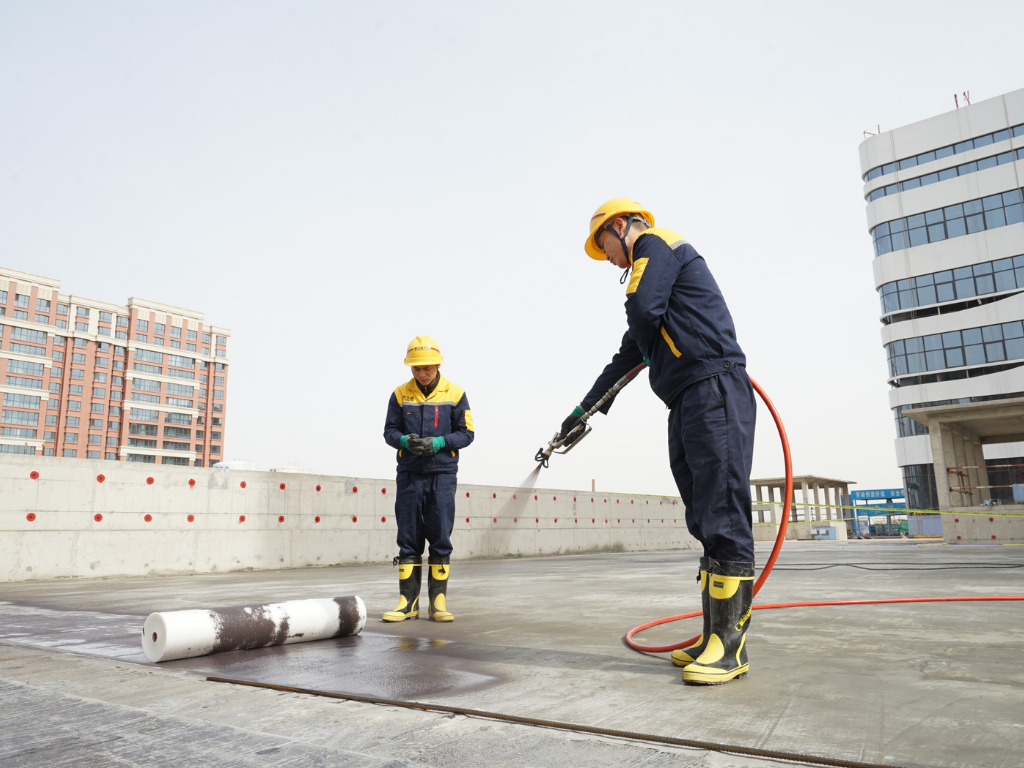
The Waterproofing Accreditation Scheme is the trade-specific credential. The Singapore Concrete Institute runs it with criteria developed jointly with BCA, and accredited firms are audited annually to keep their grade.
Four grades apply. Under SCI’s criteria revised 7 June 2026, W1 requires $250,000 in paid-up capital and net worth plus $5 million of waterproofing contracts over three years; W2 requires $150,000 and $3 million; W3 requires $50,000 and $1 million; W4 requires $10,000 and $100,000.
The audit reaches the site, not only the accounts. All grades must show procedures for pre-application preparation, application, protection of the completed system, staged inspections and a water ponding test after membrane application. W1 and W2 firms must run an inspection and test plan. W1 firms must also keep one supervisor per 10 workers as guidance and prepare a quality plan for jobs above 5,000 m².
Accreditation carries a CONQUAS benefit. Projects assessed under CONQUAS receive full points for the in-process check of internal wet area waterproofing when an SCI-accredited firm does the work, which is why developers specify it.
The scheme has run since September 2004, and SCI’s scheme page carries no public list of accredited firms, so ask for the current certificate and check the grade and expiry on it.
Should a waterproofing contractor inspect the site before quoting?
Always. A quotation issued without a site visit prices a guess, and leaks rarely start where they appear.
A proper survey identifies the water path. Water entering a ceiling below a bathroom can come from the floor membrane, a pipe penetration, a wall base, or a neighbouring unit’s wet area, and each has a different repair. The same applies to a basement wall, where groundwater ingress and condensation look similar but need opposite treatments.
Ask what the contractor used to reach the conclusion. Moisture meters, targeted water testing of individual fittings and areas, and where necessary an isolation test that wets one element at a time turn a guess into a diagnosis. Our guide to tracing a ceiling leak sets out that sequence.
In practice, the survey also sets the scope of associated work. Where water has already reached reinforcement, the job includes concrete repair works before any membrane goes down, because a membrane over spalling concrete fails with the substrate.
The cleaner approach is to pay for a proper investigation where the source is unclear, then let that report drive the quotation. Owners who skip it end up paying twice: once for the wrong repair, once for the right one.
What should a waterproofing quotation and method statement contain?
A quotation should name the system, the areas in square metres, the preparation work, the test, the warranty and the exclusions. A method statement should describe the sequence in enough detail that a supervisor can check each stage.
SS 637:2018 is the reference point. The code covers waterproofing of basements, floors, walls, roofs and precast elements, and it replaced CP 82:1999 in March 2018 with added guidance on external walls. A method statement that cites the code and the manufacturer’s data sheets is checkable; one that says “apply waterproofing membrane” is not.
Detailing decides durability. The document should state how upstands, floor traps, pipe penetrations, movement joints and terminations are treated, because those are where systems fail rather than in open areas.
Exclusions matter as much as inclusions. Look for who removes and reinstates tiles, who handles debris disposal, whether screed and falls are priced, and what happens if hacking reveals damaged substrate.
Certification sits behind the words. SCI’s criteria require supervisors to hold a Certificate in Waterproofing Supervision or the BCA Good Industry Practices course for internal wet areas, and workers to hold the Certificate of Accomplishment in Essential Knowledge for Waterproofing Workers, SEC(K) in Waterproofing, or valid CORETRADE registration.
Torch-on membrane or PU coating: which system should you specify?
Match the system to the substrate, the exposure and the access, not to the contractor’s preference. Sheet membranes suit large regular areas; liquid systems suit complex geometry.
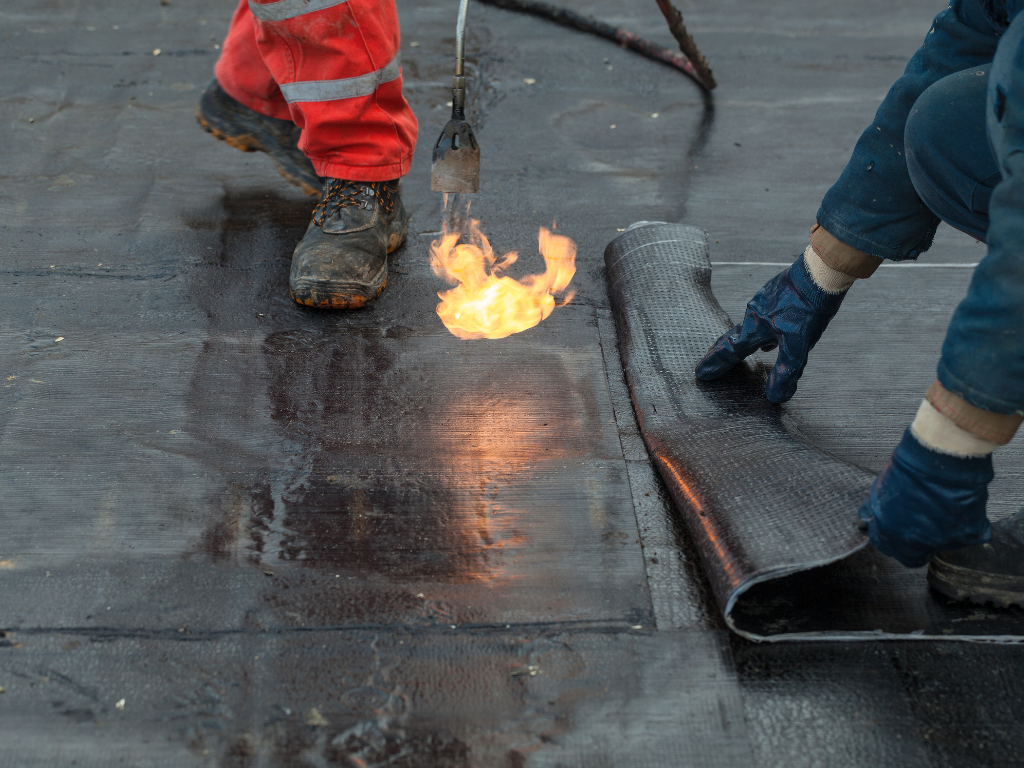
Torch-on bituminous sheets are laid in rolls and bonded with a gas torch, which makes them efficient across flat roofs, podium decks and large basement slabs. The limitation is geometry: every upstand, corner and pipe penetration needs cutting and detailing, and the quality of those laps decides the outcome.
Liquid polyurethane coatings are applied by roller or spray in multiple coats, forming a continuous film that handles irregular areas, planter boxes and roofs crowded with services. They demand accurate mixing and film thickness, so the method statement should state wet film thickness per coat and the number of coats.
Cementitious slurries are the usual choice under tiles in bathrooms and kitchens, where the membrane must bond and accept tile adhesive directly.
Exposure changes the answer again. On an exposed flat roof, UV resistance and foot traffic matter; in a basement, hydrostatic pressure and the ability to work from the negative side matter.
How do you prove the waterproofing actually works?
Require a water ponding test before any finishes go on, and require the records. BCA’s Quality Mark Scheme guide sets ponding at a minimum of 24 hours, and wet area water-tightness testing is part of CONQUAS assessment.
The sequence matters. Floor traps and openings are sealed, water is filled to a stated depth, the area is left for at least 24 hours, and the ceiling and walls below are checked for seepage. BCA’s Quality Mark guide also requires a written method statement for the ponding test, submitted two weeks before the test on assessed projects.
Waiting time before the test depends on the system, and the manufacturer’s data sheet states it. Testing a coating before it has cured produces a false failure; tiling over an untested membrane produces an expensive one.
Ask for the handover pack in the contract: dated photographs of substrate preparation and each coat, the ponding test record with start and end times, product batch details, and the signed warranty. That pack is what the next contractor or Competent Person reads in five years.
Where this breaks down is the job that gets tiled over the same week the membrane goes down, with no test record. Nobody can tell afterwards whether the membrane or the tiling caused the leak.
Do you need MCST approval for waterproofing works in a condominium?
Yes for anything touching common property, and for most works inside a unit that involve hacking or affect the building’s appearance. Section 37 of the Building (Strata Management) Act bars improvements affecting the appearance of the building without the management corporation’s authority.
The practical route is the renovation permit. Most MCSTs require a permit application with contractor details, method statement, insurance, working hours and a deposit, and they restrict noisy hacking to weekday hours.
Ownership decides who pays. External walls, structural elements and the waterproof membrane attached to them are common property, so the MCST funds those repairs, while finishes inside a lot belong to the subsidiary proprietor.
Contractor documents get scrutinised here. Managing agents ask for the public liability insurance sum, workmen’s compensation cover, bizSAFE status and the work-at-height plan before issuing the permit, so a contractor that cannot produce them delays your job.
Timing follows the council calendar. Where the repair is funded from MCST funds rather than a unit owner’s own budget, the quotation has to reach a council meeting or general meeting before any permit is issued, which adds weeks that a landed job never sees.
What changes for condo, commercial and landed jobs?
The technical work is similar; the approvals, access and decision-makers are not. A condo job runs through the MCST, a commercial job through the building owner or managing agent with tenant coordination, and a landed job through the homeowner directly.
Condominium work happens in occupied buildings. Access to units below is needed for leak testing, notice periods apply, and the MCST’s permit conditions govern working hours. Budget approval follows the council’s cycle.
Commercial buildings add continuity requirements. Roof and basement works are staged around tenant operations, night works are common, and the contractor needs a permit-to-work system that fits the building’s procedures. The same vetting logic applies as when vetting a roofing contractor for a large flat roof.
Landed houses move fastest, with one decision-maker and fewer permits for internal wet areas. Scope creep is the risk: a bathroom leak can uncover failed screeds or corroded pipework.
Older tall buildings bring a further layer. Where external wall works sit on a facade over 13 metres and more than 20 years old, coordinate them with facade inspection requirements, because one access setup can serve both the inspection findings and the waterproofing works.
Conclusion
Credentials narrow the field, but the contract decides the outcome. A firm with a current CR13 grade and SCI accreditation still needs to survey the site, write a method statement against SS 637:2018, name its products, pass a 24-hour ponding test and hand over the records. Owners who insist on those five things in writing get a system they can maintain, and a paper trail the next contractor can read.
Send Proof-Tech your leak photographs, floor plan and building type for a site survey and an itemised waterproofing quotation with the system, test plan and warranty stated.
Frequently asked questions
What is the difference between W1 and W3 waterproofing accreditation?
Scale and quality system depth. Under SCI’s June 2026 criteria, W1 requires $250,000 in paid-up capital and net worth plus $5 million of waterproofing contracts over three years, while W3 requires $50,000 and $1 million. W1 and W2 firms must maintain an inspection and test plan, and W1 firms must prepare a quality plan for jobs above 5,000 m².
How long should a water ponding test run?
At least 24 hours. BCA’s Quality Mark Scheme guide, revised 22 May 2025, requires bathrooms to be ponded for a minimum of 24 hours on the completed flooring, with any unit showing leakage re-assessed. Sealing of floor traps and openings should follow the contractor’s submitted ponding method statement.
Is a waterproofing warranty required by law in Singapore?
No. No statute sets a warranty period for waterproofing repairs to existing private buildings, so the warranty is whatever your contract says. SCI’s accreditation criteria require accredited firms to provide a warranty “as per client requirement”, which puts the onus on owners to specify the years, the covered defects and the exclusions.