


Facade spalling repair after inspection starts the day a Competent Person’s PFI report classifies concrete as “Require Repair” or “Unsafe”. Singapore buildings carbonate at roughly 7 mm per square root of year, several times the rate measured in temperate climates, so carbonation can reach reinforcement by the 20-year PFI mark. This blog walks you through the response required under your periodic facade inspection obligations.
What does spalling in a facade inspection report actually mean?
Spalling means concrete has cracked and broken away from the surface. On facades, the cause is almost always corroding steel reinforcement behind it. In a PFI report it appears as a defect under “Spalling/ delamination/ cracking of concrete”, and the Competent Person must classify the affected facade type as “Safe”, “Require Repair” or “Unsafe”.
BCA’s PFI Guidelines define those classifications precisely. “Require Repair” means the facade is deteriorating but poses no imminent danger. “Unsafe” means the facade is dangerous and needs immediate attention and repair. Industry terms such as “severity classification” or “critical defect” are shorthand; the classification in your report is the one BCA enforces.
The report should also explain why the spalling happened. The Guidelines ask for an analysis of causes for every defect classified “Require Repair” or “Unsafe”, and section 11.4.7 requires a repair proposal with method, materials, precautionary measures and timeframe.
Worth noting: that proposal covers the entire facade, not just the areas the inspector sampled. Close-range inspection checks at least 10% of each elevation, so a Competent Person who finds spalling in the sample is expected to plan for the same defect across the other 90%.
Spalling also turns up in places owners overlook. BCA’s Guidelines list spalling of the concrete substrate above suspended ceilings, and spalling of concrete nibs that support brick facades, among its vulnerable facade examples.
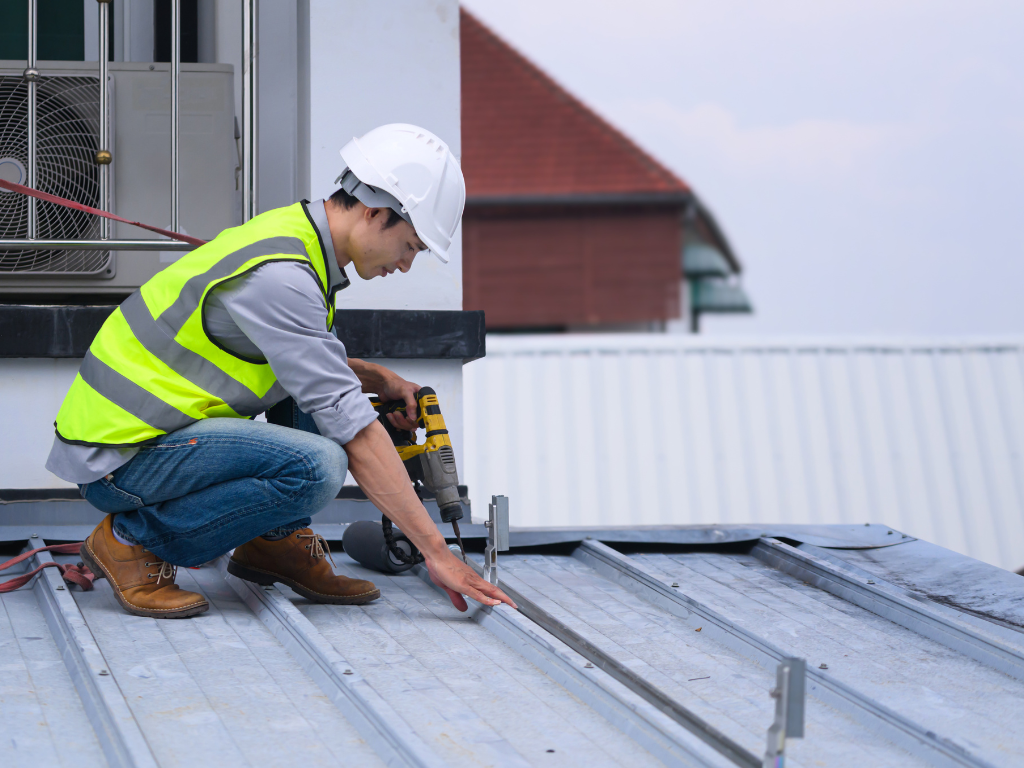
What causes concrete spalling on Singapore facades?
Reinforcement corrosion causes most facade spalling. Rust occupies more volume than the steel it replaces, and that expansion cracks the concrete cover until pieces break away.
Carbonation starts the process. Carbon dioxide from the air slowly neutralises the concrete’s alkalinity, and once the carbonation front reaches the steel, the protective passive layer on the reinforcement breaks down. Moisture and oxygen then drive corrosion.
Singapore’s climate speeds this up. A study by Roy and colleagues, published in the Magazine of Concrete Research, measured four Singapore reinforced concrete buildings aged 7 to 59 years. Their carbonation constants ranged from 5.5 to 8.6 mm per square root of year, against 1 to 3 in temperate climates, which the authors linked to lower concrete grades and Singapore’s mean daily temperature of 27°C.
Run the maths on a 20-year-old building. At 7 mm per square root of year, average carbonation depth reaches about 31 mm, and the study found maximum depths 2.1 to 2.8 times the average on the same structure. Where cover is thin on a ledge or sunshade, the front can pass the steel before the first PFI notice arrives.
Water does the rest. Leaking roofs, failed sealants and ponding on ledges keep the concrete wet, which is why water ingress into facades and spalling tend to appear together.
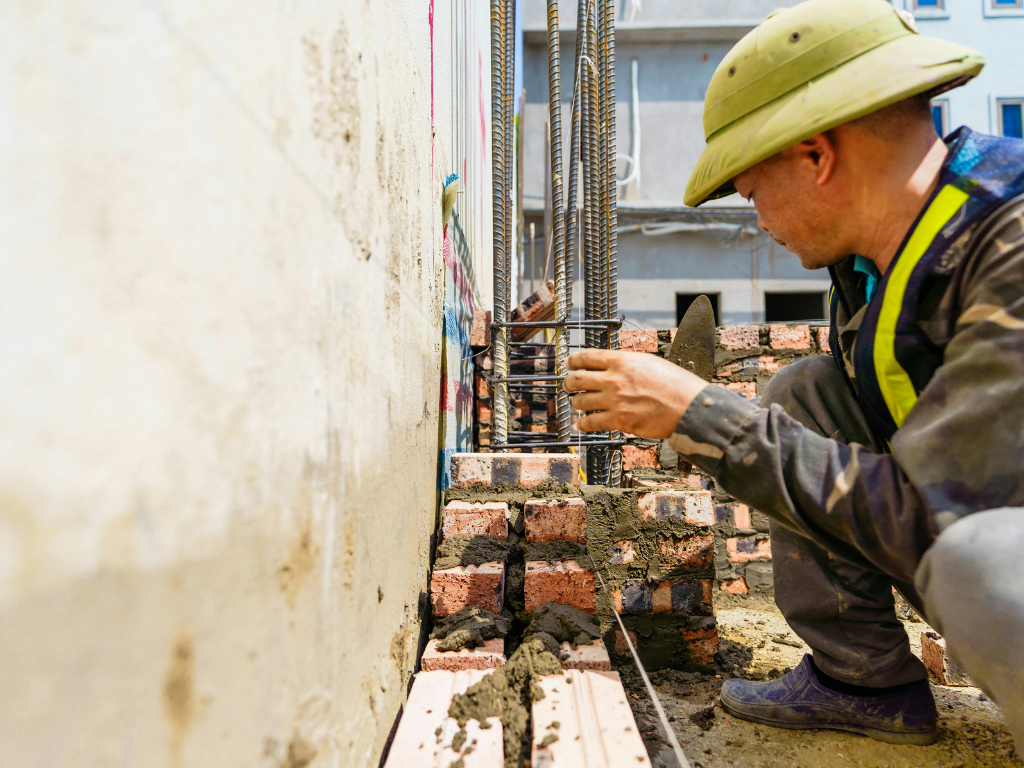
What must you do immediately after the report flags spalling?
Make the area safe first. BCA’s Guidelines require the Competent Person to recommend immediate measures for both “Require Repair” and “Unsafe” facades, and any loose or dangling element must be removed immediately.
In practice, that means three actions in the first days. Loose concrete is knocked down under controlled conditions. The ground below is cordoned off, or protective hoarding goes up over walkways, driveways and entrances. Residents and tenants are told which areas to avoid.
Remove before you repair. A contractor should hammer-sound the area around every flagged spall, because concrete that sounds hollow will fall on its own eventually, whether or not it appears in the report.
If a piece falls before this happens, a separate legal duty applies. The Building Control (Reportable Matters) Regulations 2025 require the incident to be reported to BCA’s safety incident hotline within 6 hours of becoming aware of it, followed by a written report within 24 hours.
Worth noting: make-safe works are not the rectification. They buy time, but hacking off loose concrete exposes more steel to air and rain, which accelerates corrosion if permanent repairs are delayed.
How long do you have to repair spalling after a PFI?
As long as the Commissioner of Building Control specifies in writing. After BCA accepts the Competent Person’s report, it writes to the owner with the period for completing the recommended works, and section 28(7) of the Building Control Act binds the owner to that period.
“Unsafe” findings leave no room for waiting. The Guidelines describe them as requiring immediate attention, and the make-safe measures cannot wait for BCA’s letter.
For “Require Repair” findings, the Competent Person’s own proposed timeframe in section 11.4.7 of the report shapes the period. Owners who plan the contract as soon as the report is submitted, rather than after BCA’s letter arrives, gain the vetting time.
The penalties are real. Under section 28(9), an owner who fails to carry out the recommended works without reasonable excuse faces a fine of up to $20,000, up to 12 months’ imprisonment or both, plus $500 for every day the failure continues.
If the period is too short for proper curing, access or a tender, write to BCA before it runs out with a programme and reasons. BCA considers extension requests case by case.
Does spalling repair need a Professional Engineer or BCA approval?
Repairs to structural elements do. BCA’s Guidelines state that where the repair involves structural elements or works, structural plan approval and a permit to commence structural works must be obtained before repairs start, where applicable.
Structural elements include beams, columns, slabs, load-bearing walls and cantilevers. Spalling on a balcony slab edge, a column face or a cantilevered sunshade sits on one of them. Spalling on a non-structural plaster band or a decorative feature does not.
The Guidelines also set supervision rules. Where the Competent Person is a Professional Engineer, BCA recommends appointing them to supervise the repairs. Where the Competent Person is an architect, the owner must appoint a Professional Engineer to supervise. Section 10.3 advises engaging a civil or structural PE whenever the defects involve structural elements.
Only a PE in the civil or structural discipline can apply for structural plan approval, according to BCA’s structural plan submission guidance.
Our position: involve a civil or structural PE for every spalling repair that exposes corroded reinforcement, even where approval turns out not to be needed. The PE decides whether section loss requires new bars, and that decision changes both cost and safety. For repairs that do, structural repair works should follow the PE’s design.
How is facade concrete spalling repaired properly?
A durable spalling repair removes all contaminated concrete, treats the steel, and rebuilds the cover with a repair mortar suited to the element. BCA’s Approved Document points to BS EN 1504 for products and systems used to repair concrete structures.
| Step | What happens | Why it matters |
| 1. Survey the extent | Hammer-sound around each spall; check cover depth and carbonation with phenolphthalein on exposed concrete | Visible spalls understate the damaged area |
| 2. Hack back to sound concrete | Break out cracked and carbonated concrete beyond the corroded length, and behind the bar so it is fully exposed | Leaving carbonated concrete against the steel restarts corrosion |
| 3. Clean the reinforcement | Remove rust by grit blasting or mechanical wire brushing | Coatings and mortar need clean steel to bond and protect |
| 4. Assess section loss | The PE decides whether bars need lapping or replacement | Heavily corroded bars no longer carry their design load |
| 5. Protect the steel | Apply a reinforcement protective coating | Restores protection to steel exposed by hacking |
| 6. Prepare the substrate | Clean, saturate or prime the concrete as the mortar maker specifies | Controls bond between old and new concrete |
| 7. Reinstate the section | Apply polymer-modified repair mortar in layers, restoring at least the original cover | Rebuilds alkaline protection around the steel |
| 8. Cure and protect | Cure as specified, then apply an anti-carbonation or protective coating | Slows the next carbonation cycle |
Mortar class matters. BS EN 1504-3 classes repair mortars from R1 to R4, and only R3 (at least 25 MPa compressive strength) and R4 (at least 45 MPa) are structural classes. A cosmetic R1 or R2 mortar has no place on a balcony slab or column.
Any contractor offering concrete spalling repair services should name each product and its EN 1504 class in the method statement.
Why do spalling repairs crack again within a few years?
Most repeat failures come from shallow patching, or from the incipient anode effect around the repair. Both leave corrosion active in the concrete next to the patch.
Shallow patching skims a mortar layer over cracked or carbonated concrete without exposing and treating the steel. The corrosion continues underneath, and the patch pops within a few wet seasons.
The incipient anode effect is subtler. Once corroded steel inside a patch is repaired and repassivated, nearby steel in the surrounding carbonated concrete can start corroding faster, producing new spalls in a ring around the old repair. Migrating corrosion inhibitors and anti-carbonation coatings on the surrounding area reduce this risk, and a wider hack-back boundary removes the worst of it.
Tropical conditions make generic service life estimates unreliable. A 2025 study by Li Soon Wan, Kang Hai Tan and colleagues, published in Case Studies in Construction Materials, found that current durability assessment “tends to overestimate the service life of carbonated RC structures in tropical climates.” The same study singled out the lower-strength concrete used in Singapore buildings of the 1960s and 1970s.
The cleaner approach is to treat each spall as a symptom of a facade-wide carbonation problem, and to budget for protective coating as part of tropical climate maintenance rather than as an optional extra.
What should a facade spalling repair quotation include?
A proper quotation prices measured repair quantities, a provisional sum for hidden damage, access, and PE supervision as separate lines. A single lump sum for “spalling repair” is impossible to compare.
Ask for rates per square metre of hacking and reinstatement at stated depths, per linear metre of rebar treatment, and per metre of bar replacement where the PE requires it. Ask for the mortar product name and its BS EN 1504-3 class, and the coating system.
Hidden damage deserves an honest line. The Competent Person’s report quantifies what was visible or tapped. Hacking reveals more, so a provisional sum paid against measured work protects the owner from open-ended variations.
Access is a major cost on scattered defects. A temporary gondola needs PE-designed outriggers, while rope access for facade repairs reaches isolated spalls on ledges and sunshades with far less roof work.
Public tenders show the scale. On GeBIZ, the National Heritage Board awarded $1,905,800 in June 2024 for localised repairs at the Asian Civilisations Museum covering water seepage, cracked reinforced concrete columns, re-waterproofing, plaster and painting.
Proof-Tech is registered with BCA under specialist workhead CR05 Concrete Repairs, alongside CR09 Repairs and Redecoration and CR13 Waterproofing Installation.
How do you close out spalling repairs with BCA?
Submit completion evidence. BCA’s Guidelines require the owner to submit photographs of the completed repairs and a certification that the repairs were carried out according to the Competent Person’s recommendations and supervised by a Professional Engineer or the Competent Person.
BCA provides a Completion of Remedial Works Report template for this purpose. Build the photographic record during the works, not after: each repair location photographed at hack-back, after steel treatment and after reinstatement, cross-referenced to the defect numbers in the PFI report.
The record pays off at the next inspection. Seven years later, a new Competent Person can see exactly where concrete was repaired, which products were used and how deep the hack-back went. Repairs without that record look like new defects.
Keep the PE’s supervision records with the photographs. BCA’s certification asks that the repairs were supervised to the PE’s or Competent Person’s satisfaction, and inspection notes made on the day are the proof if BCA queries a location.
Conclusion
Spalling in a PFI report is the visible end of a carbonation process that Singapore’s climate runs several times faster than temperate cities. That is why the fix has to go deeper than the crack. Make the area safe immediately, involve a civil or structural PE wherever steel is exposed, hack back to sound concrete, and use structural-class mortar with protection for the surrounding concrete. Document everything for BCA and the next inspection.
Send Proof-Tech your PFI report for an itemised spalling repair quotation with measured quantities, EN 1504-classed materials, a provisional sum and access priced separately.
Frequently asked questions
Can we just plaster over facade spalling?
No. Plastering over spalled concrete leaves carbonated concrete and corroding reinforcement in place, so the steel keeps expanding and the plaster falls away. BCA’s PFI Guidelines require repairs that restore the integrity of the facade, and a Competent Person must later certify the completed works for BCA.
Who pays for spalling on a condo balcony?
The MCST pays in most cases. The Building (Strata Management) Act counts structural elements such as slabs, beams and cantilevers as common property, even within a lot. A balcony slab edge spalling from rebar corrosion is therefore an MCST repair, while tiles or finishes a unit owner added remain the owner’s responsibility.
Can spalling be repaired using rope access?
Yes, for localised spalls on ledges, sunshades and slab edges. Rope access technicians can hack, treat and reinstate small repair areas from a harness, while larger areas needing heavy breakers or extensive formwork suit a gondola or scaffold. Rope access work should follow SS 588 and MOM’s work-at-height rules.