

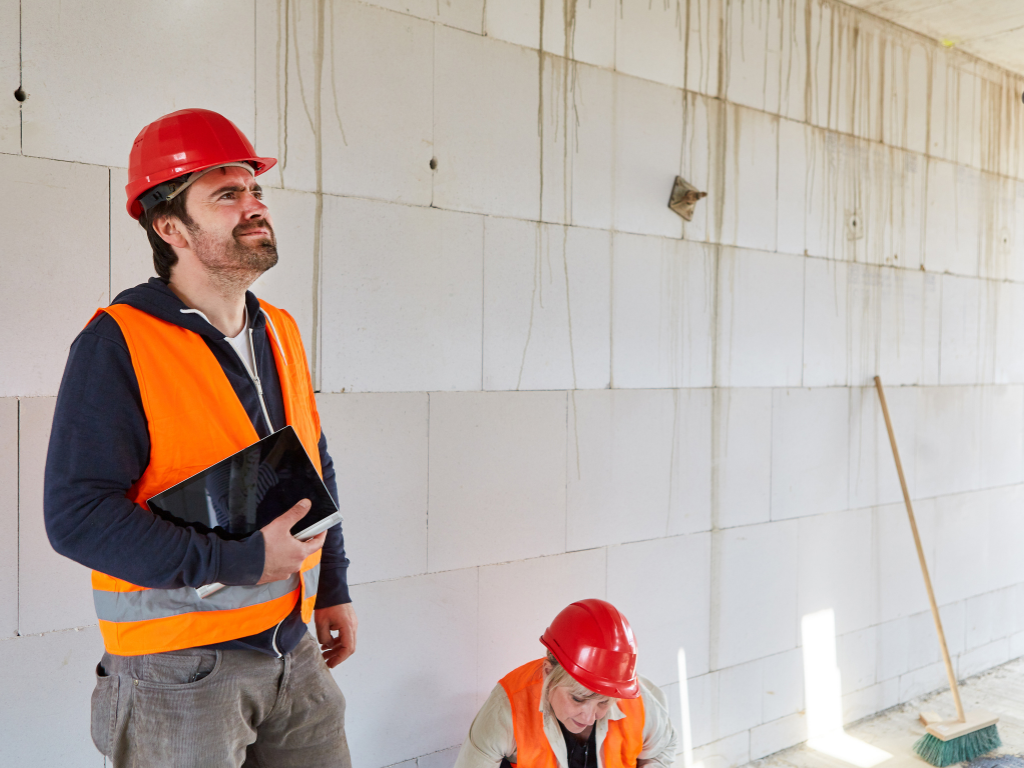
Competent person facade inspection rules in Singapore allow only a Professional Engineer or Registered Architect who has passed BCA’s Certificate in Façade Inspection to sign a PFI report. Accredited facade inspectors assist, but never sign. BCA’s public list held 324 Competent Persons in September 2026, up from 149 in 2021. This blog walks you through each role and periodic facade inspection support.
Who is allowed to carry out a periodic facade inspection in Singapore?
Only a Competent Person can carry out and sign off a periodic facade inspection. The Building Control Act defines a Competent Person as a qualified person, meaning a Registered Architect or Professional Engineer holding a practising certificate, who meets the requirement prescribed in the PFI Regulations.
That requirement is a single course. Regulation 9 of the PFI Regulations 2021 requires the qualified person to attend and pass the Certificate in Façade Inspection developed by the Building and Construction Authority. BCA’s PFI FAQ describes eligible engineers as Professional Engineers in the civil or structural discipline.
The Competent Person can bring in help. Facade inspectors assist with the visual survey and close-range checks, but regulation 16 makes both inspections the Competent Person’s personal duty, discharged through inspectors only under the Competent Person’s direct supervision and control.
Parliament set the tone when the regime was introduced. Minister of State Zaqy Mohamad told Parliament on 6 March 2020 that “inspections must be conducted by trained personnel every seven years.”
Owners carry the appointment duty. Regulation 12 requires the building owner to appoint a Competent Person within 2 months of the facade inspection notice, with fines of up to $20,000 for failing to do so.

What qualification does a Competent Person need?
A Competent Person needs two things: registration as a Professional Engineer or Registered Architect with a current practising certificate, and a pass in the Certificate in Façade Inspection.
BCA Academy runs the course as synchronous e-learning, with the next run on 18, 19, 20 and 23 November 2026. It covers the legislative framework, work-at-height requirements, precast concrete, masonry and plaster facades, glass walls, and claddings and canopies, with failure case studies for each. Participants need at least 75% attendance and a pass in a multiple-choice assessment.
The full fee is $1,665 including GST. After SkillsFuture funding, eligible Singaporeans and PRs pay $901.24, or $595.74 for Singaporeans aged 40 and above and SME-sponsored participants. The course carries 23 PDUs for Professional Engineers Board purposes.
IES Academy also offers the course, and the Regulations accept any version conducted or developed by BCA, solely or jointly with another party.
Worth noting: regulation 9 sets no expiry for the course certificate, but the practising certificate must stay current. An engineer whose Professional Engineers Board practising certificate has lapsed is no longer a qualified person, and therefore cannot act as a Competent Person, however long ago they passed the course.

What is a facade inspector, and what qualifications do they need?
A facade inspector is an individual who assists a Competent Person, or carries out the inspection under the Competent Person’s direct supervision and control. The Building Control Act requires three things: that role, a prescribed qualification and experience, and accreditation with BCA or a prescribed organisation.
Every route starts with the same Certificate in Façade Inspection. Regulation 10 then adds one of 12 qualification-and-experience combinations. A civil or structural engineering degree recognised by the Professional Engineers Board needs only 3 continuous months of relevant work experience. A local construction diploma needs one year of structural site supervision or facade-related work. A foreign civil engineering diploma needs 2 years. Candidates with ITE or GCE qualifications need 10 years of facade-related experience within the previous 12 years.
Registered Architect-track degrees, Chartered Building Surveyors with the Royal Institution of Chartered Surveyors, and Chartered Engineers registered with the Engineering Council UK are also covered.
The registry is built around site supervision. Its Group 1 covers current Resident Engineers and Resident Technical Officers who have passed the course, and those already registered with IES as civil and structural RE or RTO skip the interview.
Is there a registered facade inspector list, and how does accreditation work?
Yes, but the registration is with the Joint Accreditation Committee, not BCA. Regulation 11 names the committee set up by the Institution of Engineers, Singapore (IES), the Association of Consulting Engineers Singapore (ACES) and BCA as the accreditation body for facade inspectors.
The committee operates the IES/ACES C&S Facade Inspector Registry. Its co-chairs are Er. Chan Ewe Jin for IES, Er. Sivakumaran Murugesu for ACES and Er. Lee Chee Weye for BCA.
Registration lasts 12 months. The registry charges a $40 application fee, a $100 interview fee where an interview is held, and $120 for each 12-month registration or renewal, all before GST. Civil and structural REs and RTOs already registered with IES get 50% off.
Renewal requires continuing training. Group 1 inspectors, who hold a valid RE or RTO certificate, need 4 structural STU points and 2 facade inspection STU points. Group 2 inspectors need 6 facade inspection STU points. Renewal takes about 2 to 4 weeks.
BCA’s September 2021 announcement counted 140 facade inspectors when the regime was about to start. The rope access list the registry published in August 2026 includes registration numbers as high as FI-0442.
Who signs off the PFI report, and can a facade inspector sign it?
The appointed Competent Person signs. Regulation 17 makes the Competent Person responsible for preparing the report and assessing the facade’s condition, and the facade inspector’s legal role ends at supplying results to that person.
Regulation 16B, in force since 1 October 2025, sets the facade inspector’s duties precisely. The inspector must carry out the visual or close-range inspection with reasonable diligence under the Competent Person’s instructions, provide the results to the Competent Person, and notify the Competent Person in writing immediately if they suspect a risk of facade collapse.
The report the Competent Person signs has fixed contents under regulation 17(3): a detailed description of the visual and close-range inspections and any full facade investigation, analyses of the observations and tests, and recommendations for building works needed to prevent collapse.
Where drones or other approved equipment are used, the Competent Person must personally review all photographs, images and readings under regulation 16(3). A drone provider’s defect summary therefore cannot stand in for the Competent Person’s own assessment.
Where this breaks down is the inspection firm that sends a facade inspector to present findings to the MCST council while the Competent Person has little contact with the site. The signature commits the Competent Person to findings the Regulations require them to supervise directly.
How do you check that a Competent Person or facade inspector is qualified?
Check three things for a Competent Person and two for a facade inspector. For the Competent Person: current registration and practising certificate with the Professional Engineers Board or Board of Architects, the Certificate in Façade Inspection, and independence from the building. For the inspector: current Joint Accreditation Committee registration and the certificate.
BCA publishes a Competent Person list on its periodic facade inspection page. The version downloaded on 16 September 2026 contains 324 names. Inclusion is voluntary, so absence from the list is not disqualification; ask for the course certificate instead.
Rope access inspectors need a second check. The IES registry’s August 2026 list of facade inspectors with rope access certification names 52 people: 35 at IRATA Level 1, 4 at Level 2 and 13 at Level 3. Only 43 of those FI registrations run to 31 December 2026; the rest show validity ending in 2023, 2024 or 2025. 29 of the listed IRATA certificate due dates had already passed by 16 September 2026, leaving 20 people with both dates current on the published list.
Our position: ask for both expiry dates in writing before any inspector goes over the edge. Treat a list titled “valid” as a starting point and ask for the certificates themselves, because rope access on Singapore facades needs current certification to be safe as well as compliant.
Who cannot act as the Competent Person or facade inspector?
A Competent Person cannot have any professional or financial interest in the building, and a facade inspector cannot be a partner, officer or employee of the owner, the builder, or anyone doing building works on the facade.
Section 29 of the Building Control Act sets the Competent Person’s independence. BCA’s FAQ gives the clearest example: a Professional Engineer or architect who designed or built any part of the building cannot inspect it.
Regulation 16A, added on 1 October 2025, applies the same logic to inspectors. It also extends to associates of the owner, the builder or the facade works contractor, which catches related companies inside a group.
The practical consequence is a clean split between inspection and repair. A contractor that will price the remedial works should not supply the Competent Person or the facade inspectors for the same building. It can still provide rope access crews or other access equipment, but the person holding the tapping rod and the person signing the report must come from outside.
Should an MCST appoint an engineer or an architect as Competent Person?
Either can sign the report, but appoint a civil or structural Professional Engineer when the facade includes load-bearing or cantilevered concrete. BCA’s PFI Guidelines advise engaging a civil or structural PE whenever defects involve structural elements.
A Registered Architect brings strength on building envelope design: cladding systems, glazing, waterproofing details and material specifications. For a curtain wall office tower with few exposed concrete elements, that expertise fits the risk.
Older condominium blocks with reinforced concrete and plaster facades, cantilevered balconies, air-conditioner ledges and projecting sunshades carry a different risk. When the close-range inspection finds corroded reinforcement in those elements, the recommendations lead to structural repairs to facade elements, and a PE (civil or structural) will need to design them anyway.
The cleaner approach for concrete-framed buildings is a PE who can carry the findings straight into the remedial design. BCA’s FAQ also confirms that a PE (civil or structural) holding the facade certificate can handle concurrent PSI and PFI notices, with separate reports.
What happens if the Competent Person or facade inspector gets it wrong?
Both face criminal liability. A Competent Person who fails to inspect in the prescribed manner or follow BCA’s directions faces a fine of up to $50,000 under section 28(10) of the Building Control Act. A facade inspector who breaches regulation 16B faces a fine of up to $20,000.
BCA also vets every report. It can seek clarifications, ask for a joint site inspection, and reject reports that do not meet the Guidelines; the Guidelines single out boilerplate reports that could fit any building as non-compliant.
The owner’s exposure does not transfer. If the Competent Person’s work is rejected or delayed, the building owner still carries the duty to submit a compliant report within the notice period, and to carry out the recommended works in time.
Professional consequences follow separately, through the Professional Engineers Board or Board of Architects disciplinary processes for their registrants.
For MCSTs, the protection is in the appointment: check credentials, confirm independence, and budget the inspection as part of tropical building maintenance planning rather than choosing the lowest fee.
Conclusion
The PFI regime separates the people who touch the facade from the person who answers for it. Facade inspectors can do most of the site work, but the Competent Person signs, supervises and carries the $50,000 exposure. For owners, the real risk sits in expiry dates and independence, which a council can verify before appointment. Appoint a PE for concrete-framed facades and keep the inspector apart from whoever prices repairs.
Once your Competent Person has issued the PFI report, send it to Proof-Tech for an itemised remedial works quotation, with access planned around the drops and defects the inspector recorded.
Frequently asked questions
Does a drone pilot need to be a facade inspector?
No, but the pilot cannot inspect alone. Regulation 16(3) of the PFI Regulations 2021 requires anyone operating approved inspection equipment to work in the presence of the Competent Person or a facade inspector. The IES registry’s drone provider list states it is not an accreditation; BCA recognises providers accredited by the Singapore Accreditation Council.
Can our PSI engineer also do the PFI?
Yes, if the engineer holds the Certificate in Façade Inspection. BCA’s PFI FAQ allows owners served both notices concurrently to appoint the same Professional Engineer (civil or structural). The engineer must still submit two separate reports, one for periodic structural inspection and one for periodic facade inspection.
Can we change competent person halfway through the PFI?
Yes. Regulation 13 of the PFI Regulations 2021 requires the building owner to appoint a replacement Competent Person within 2 months of learning the first one cannot or will not continue, and to notify BCA. Failing to appoint the replacement in time carries a fine of up to $20,000.