


Waterproofing cost in Singapore runs from about $6 per square foot for an acrylic roof coating to $22 for torch-on membrane, based on rates Singapore contractors published in 2026. Wet area membranes are quoted at $60 to $95 per square metre. BCA’s Tender Price Index has climbed 41% since 2018. This blog walks you through the numbers behind waterproofing systems and scope.
How much does waterproofing cost in Singapore in 2026?
Published contractor rates in 2026 cluster in three bands: roof and deck systems at $6 to $22 per square foot, wet area membranes at $60 to $95 per square metre, and localised leak repairs from $280 to about $5,000 depending on method and access.
| Work | Published 2026 range | Source of the figure |
| Acrylic roof coating | $6 to $10 per sq ft | DirectHome |
| Cementitious system | $6 to $12 per sq ft | DirectHome, JK Roof |
| PU coating | $8 to $15 per sq ft | JK Roof, DirectHome |
| Torch-on membrane | $10 to $22 per sq ft | JK Roof (low), DirectHome (high) |
| Removal of failed system | $3 to $6 per sq ft | DirectHome |
| Liquid membrane, wet areas | $60 to $95 per sq m | PRDT |
| Screed over membrane | $45 to $75 per sq m | PRDT |
| PU crack injection | $280 to $1,200 | General.com.sg |
| Full ceiling leak repair | $500 to $3,500 | General.com.sg |
| Flat roof, landed house, whole job | $5,000 to $25,000 | DirectHome |
Every figure above is a contractor’s own published price, not an independent benchmark. Treat them as a sanity check against your quotation rather than a target.
The cost of getting it wrong sits behind these numbers. Michael Chew of the National University of Singapore and his co-authors reported in Buildings in 2023 that “waterproofing defects were discovered in 59% of the buildings” they studied across the tropics.
Worth noting: none of these rates includes GST, which IRAS sets at 9%.
How much does roof waterproofing cost per square foot?
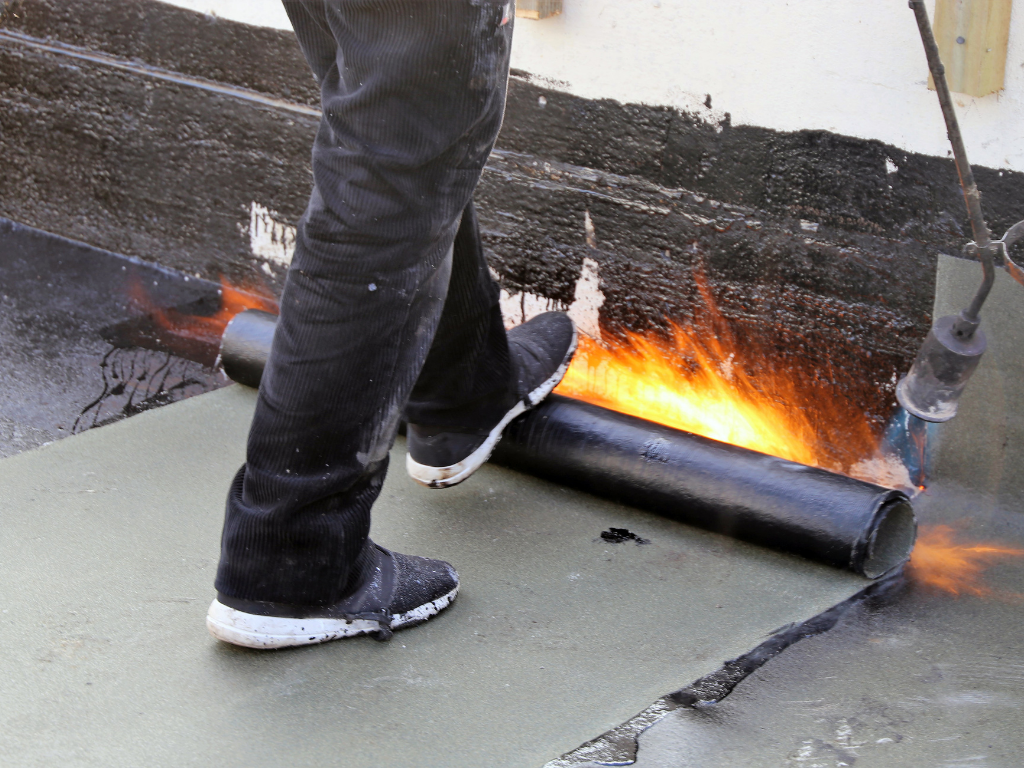
Roof rates depend on the system and the state of the existing surface. DirectHome’s June 2026 figures put acrylic coating at $6 to $10 per square foot, PU coating at $10 to $15, cementitious at $8 to $12 and torch-on modified bitumen at $15 to $22.
JK Roof’s September 2026 table prices by roof type instead: flat concrete roof at $6 to $12 per square foot, RC rooftop at $7 to $15, metal roof at $6 to $10 and pitched tile roof at $8 to $18. Its torch-on rate, $10 to $18, sits below DirectHome’s.
Convert before comparing anything. At 10.76 square feet to the square metre, $6 to $22 per square foot equals roughly $65 to $237 per square metre, which is the unit most commercial specifications use.
Removing the old system is a separate line. DirectHome prices hacking and removal of failed waterproofing at $3 to $6 per square foot, about $32 to $65 per square metre, and quotes that omit it are pricing an overlay rather than a replacement.
For a landed house with 800 to 1,500 square feet of flat roof, DirectHome puts the whole job at $5,000 to $25,000, a spread that reflects system choice and substrate condition more than roof size.
How much does toilet and wet area waterproofing cost?
Wet area work is priced per square metre for the membrane and per toilet for the package. PRDT’s 2026 guide puts liquid membrane at $60 to $95 per square metre, with cementitious screed over the membrane adding $45 to $75 per square metre.
Packaged pricing tells the same story from the other end. MoneyBees, citing contractor quotes as of June 2026, puts a single overlay toilet at $4,500 to $6,500 and a full hack-and-redo at $5,000 to $8,000, with waterproofing and screed accounting for $1,200 to $2,500 of that.
The membrane is a small share of a renovation and the whole point of one. ShiokLiving’s 2026 guide prices waterproofing remediation at $800 to $2,000 per bathroom when hacking exposes a failed membrane, and Hock Star puts waterproofing alone at $800 to $1,200. Neither is budgeted before the tiles come off.
Those packaged figures come from HDB-focused renovation firms. Condominium and landed bathrooms carry the same technical scope, plus MCST permit conditions, protection of finished areas and access restrictions that push labour time up.
One line decides whether you are buying waterproofing or tiling: the ponding test. BCA’s Quality Mark Scheme guide sets a minimum of 24 hours, and a quote without a test line has priced the membrane without proving it.
How much does a ceiling or wall leak repair cost?
Localised leak repairs run from a few hundred dollars to several thousand. General.com.sg’s 2026 table prices PU crack injection at $280 to $1,200 and a full ceiling repair combining works at $500 to $3,500, with roof repair plus ceiling reinstatement reaching $5,500.
Flux Solutions publishes a similar shape: ceiling leakage repair from $150 to over $5,000, with most leaks from an upstairs bathroom landing between $600 and $1,800 when fixed at source by PU injection, and a hairline slab crack at $300 to $600 for one or two injection ports.
Roof-origin leaks price differently again. The Roof Specialist’s 2026 guide puts minor localised roof leak repairs at $150 to $600 and major membrane replacement at $2,000 to $8,000.
The variable that decides your number is the diagnosis, because the stain is rarely under the source. Our guide to ceiling leak diagnosis sets out the sequence of isolation tests that identifies which element is leaking.
In practice, the cheapest quotation is the one that treats the stain. Repainting a ceiling costs $150 to $400 by Flux’s figures, and the stain returns with the next heavy rain.
Why do two quotes for the same job differ by half?
Because they price different scopes. The three variables that move the number are hacking versus overlay, surface preparation, and how many coats or millimetres of membrane the contractor has allowed.
Scope is the biggest gap. Stripping a failed system, repairing the substrate and rebuilding falls costs multiples of coating over the existing surface, and both can appear on a quotation as “waterproofing works”.
Preparation is where cheap quotes save money. Grinding, crack routing, priming and forming coves at upstands take labour days before any membrane goes down, and skipping them is invisible until the system fails at a detail.
Specification is the second gap. A PU system applied at two coats behaves differently from four, so the quotation should state the product, the number of coats and the wet film thickness per coat, not just the system family.
Ask each bidder to price the same written scope. A quote that is 40% cheaper with no stated preparation, no test and no product name is a different job, not a better deal.
How much does access add to a waterproofing quotation?
Access is a separate cost that scales with height and restriction, not with membrane area. Flux Solutions publishes an uplift of 15% to 25% on its repair ranges for rope-access conditions, urgent same-day callouts or condominium MCST coordination.
Public tenders show the same logic at scale. CAAS awarded a contract for “Waterproofing and Associated Works at Top of High-Rise Structure Involving Specialised Access” at $928,500 in September 2021, where the access method was significant enough to name in the tender title.
Three methods carry three cost shapes. Scaffold is priced per square metre of elevation plus erection time, a gondola needs roof anchorage and Professional Engineer-designed outriggers on temporary installations, and rope access crews mobilise faster for scattered or recessed work.
Ask for access as its own line in the quotation. It lets you compare two bidders who chose different methods, and it tells you what a second visit will cost if the first repair does not hold.
What do condominium and commercial waterproofing jobs cost?
Building-scale works run from tens of thousands to several million dollars. Public sector awards recorded in the GeBIZ procurement dataset give verifiable reference points.
| Agency | Scope in the tender description | Award date | Awarded amount |
| JTC Corporation | Replacement of waterproofing system, Revenue House and The Treasury | April 2025 | $5,032,000 |
| Civil Aviation Authority of Singapore | Waterproofing at top of high-rise structure, specialised access | September 2021 | $928,500 |
| Civil Service College | Waterproofing to roof and roof terraces | February 2025 | $298,600 |
| Ngee Ann Polytechnic | Waterproofing and improvement works, Blk 80-83 Level 3 outdoor area | January 2026 | $225,096.88 |
| Urban Redevelopment Authority | Re-roofing and waterproofing, URA Centre and East Wing | July 2023 | $186,200 |
| Central Provident Fund Board | Waterproofing works, CPF Tampines and Jurong buildings | March 2023 | $71,661 |
These are whole-building or multi-block contracts, so they set the scale rather than a rate. In practice, a single-block scope such as a podium deck, a basement or a commercial roof waterproofing replacement looks more like the CPF or Civil Service College figures than the JTC contract.
Sinking fund timing matters more than the rate at this scale. An MCST approves the budget at a general meeting, so a quotation obtained in March is tendered months later, by which time material and labour costs have moved.
What gets left out of a cheap waterproofing quote?
Six lines disappear from low quotations: substrate repair, removal and disposal, protection and reinstatement of finishes, the ponding test, access equipment, and GST.
Substrate repair is the expensive surprise. Where water has reached reinforcement, the scope includes concrete repair before membrane work, and a membrane laid over spalling concrete fails with the substrate under it.
Disposal and protection follow. Hacked tiles, old bitumen sheets and screed have to leave the building, and finished areas around the works need protection in occupied condominiums and offices.
Verification and paperwork round it off. The 24-hour ponding test, the photographic record, the warranty document and the MCST permit submission all take time somebody has to price.
GST at 9% applies on top unless the quotation states otherwise, which turns a $20,000 quotation into $21,800 payable.
The cleaner approach is a quotation with a provisional sum for substrate repair. It caps the risk in writing instead of surfacing as a variation order once hacking starts.
Have waterproofing prices risen in Singapore?
Yes, and mostly before 2023. BCA’s Tender Price Index rose from 98.6 in 2018 to 130.7 in 2022, then to 137.7 in 2024 and 139.1 in 2025, a total of about 41% across those seven years.
Recent movement is mild. The 2024 to 2025 change works out at roughly 1%, so a quotation from last year remains a reasonable reference; one from 2019 does not.
Material costs move on their own cycle. The Roof Specialist’s 2026 guide reports polymer-modified bitumen and PVC membrane imports rising about 12% since 2024, and puts labour at 40% to 55% of a typical repair invoice.
Two practical consequences follow. Sinking fund estimates set at the last repair cycle need rebasing before a tender, and a fixed price held open for months should state a validity period.
The same discipline applies to comparing contractor quotes: compare quotations issued within the same quarter, since a six-month-old price and a current one are not the same offer.
Conclusion
Published rates give you a range; the scope in the quotation gives you the price. Roof systems sit between $6 and $22 per square foot depending on the system and whether the old one comes off, and leak repairs start near $280 when the source is a single crack. What separates a $12,000 roof from a $20,000 roof is preparation, access, testing and substrate risk.
Send Proof-Tech your roof or wet area dimensions, leak photographs and building type for a site survey and an itemised quotation showing preparation, membrane system, ponding test, access and GST as separate lines.
Frequently asked questions
Is GST included in waterproofing quotes in Singapore?
Rarely. GST has been 9% since 1 January 2024, and Singapore contractors quote before tax, so a $20,000 scope costs $21,800. Ask whether the figure is inclusive, and check that the company is GST-registered before accepting a quotation that adds tax.
Do waterproofing contractors charge for a site inspection?
Expect a fee for leak investigation work, and ask for it to be credited against the works if you proceed. An investigation buys a diagnosis instead of a guess, and the proof comes later from the 24-hour ponding test that BCA’s Quality Mark Scheme guide sets as the minimum.
Is overlay cheaper than hacking in the long run?
Only if the existing membrane is sound. MoneyBees puts a single overlay toilet at $4,500 to $6,500 against $5,000 to $8,000 for a hack-and-redo in 2026, but overlay keeps the old membrane, so a failure in year four costs the repair plus the neighbour’s ceiling reinstatement.